
Life, love, slavery, and crucifixion in antiquity.
Readership: All
Author’s Note: This post is based on a discussion between Jack and NovaSeeker, and is augmented with a curation of comments on Σ Frame about ancient Roman culture. Links to the original comments are contained in the first word of the paragraph.
Reader’s Note: I’m no expert in history, so I make no claim of authority concerning the content of this post. Instead, I’ll only state that the views contained here reflect those of our readers.
Length: 3,500 words
Reading Time: 12 minutes
Rome? Who Cares About a Bunch of Pagans? Aren’t we Christians?
The Roman Empire is something of a historical Rorschach test: how one reacts to it, conceptually and viscerally, tends to be very revealing of the person, much more than it is of history itself.
Rome was the foundation of the West, and the foundation of Christendom. It was the basic substrate on which everything that came later in the West was built — institutions of religion, state, law, language, culture, and the like. The influence is pervasive and vast, and persists well into the present-day in all of these areas, in nations that are both Catholic, Protestant and now Secular in cast. Rome’s legacy therefore cannot be ignored without remaining ignorant of the roots of much of our current practices and culture, particularly on an underlying, institutional level. In many respects, Rome (and the broader Greco-Roman culture that Rome enshrined in itself) simply is the West in its foundations.
And yet life in Roman times was, of course, in many ways rather different from our own. This is to be expected, given the great span of time involved, and the many changes in technology, economy, ideas and political structures between now and then. This article will examine some of these areas of Roman life, as they were lived during the time of the Roman Empire.
 Via Appia, “The Appian Way”, Italy.
Life under Roman Law
The ancient Romans were strict disciplinarians, with very harsh punishments imposed for significant crimes and defeated enemies, such as scourging with cat-o-nine tails and crucifixion. The Appian Way is a road in Italy whose history is a poignant symbol of this. In 71 AD, the Romans crucified 6,000 rebels along a 200 km. (120 mi) stretch of the Via Appia from Rome to Capua, serving as a gruesome reminder to anyone traveling that way that the Romans should not be reviled. That is an average of one cross every 33.3 meters! (109 ft.)
A payslip made from a sheet of papyrus shows a Roman soldier was left penniless 1,900 years ago after the military took out fees for certain items. The document was made out to a Gaius Messius, who participated in the Siege of Masada that was one of the last battles during the First Jewish-Roman War. The receipt shows Messius received 50 denarri as his stipend, but fees for barley money, food and military equipment were taken out that totaled to the amount of his full pay.
The Romans, who had a professional army, prohibited soldiers from marrying at all until they completed their service. Oftentimes, a Roman legionnaire’s retirement pension was a piece of land in the province where he served.
A Roman legionnaire might serve his entire career in Gaul, receive a piece of land there, marry a local girl, buy a few slaves to work his land, and live the rest of his life in Gaul. That’s one way that they Romanized the provinces.
Slavery was prevalent, accounting for roughly every third person living on the Italian peninsula. The Romans (and the Ottomans) often conquered their neighbors and made slaves of them.
At one point, both the Greeks and Romans had very strict rules against homosexuality (see below), infidelity, etc. Pagan Europe, at points in time, had the death penalty for two crimes: homosexuality and being a coward.
The Romans extolled discipline and virtue for most of their history until the point where their society was in full on decline.
 The Roman Colosseum
Sex
Pagan cultures were highly sexualized. The Roman paterfamilias was buggering his catamite, and also using his other slaves for sex at times.
Francine Rivers wrote a novel series called Mark of the Lion set in the time of the Romans and the early church. One of the main characters in the series is a woman through whom the author goes into veiled depth about the extremely sexually deviant depravity of the time.
The NT epistles were written to men and women in a MORE sex saturated culture than us. Men and women were openly having sex with temple prostitutes, with their father’s wives (1 Corinthians 5), and so on. Pederasty/pedophilia (men having sex with young boys) was common in Greek and Roman culture. By contrast to these common practices, scripture called these men and women to avoid sexual immorality and avoid sex with anyone other than their spouses.
AT the same time, it is dangerous to associate Greco-Roman sexual mores with post-Sexual Revolution values. Current values are gynocentric whereas Greco-Roman ones were patriarchal. I highly recommend the book, From Shame to Sin, by Kyle Harper (PDF review) as an excellent resource on Greco-Roman sexual values and the Christian values that replaced them. Modern values are alien to both Greco-Roman and Christian values.
[What does fornication even mean? Apparently, some protestants say what is commonly called fornication is in fact your wedding ceremony (and the “fake” wedding ceremony of exchange of consent/tokens of consent was created by the pagan Roman church’s additions). All argued in meticulous detail from the KJV Bible with no possibility of a deciding authority.]
Around the time of Christ, the Roman poet Ovid wrote a famous work about “how to attract the opposite sex” called “The Art of Love” (Ars Amatoria), in which he said, regarding illicit sex:
“Whether they give or refuse, it delights women to have been asked.”
Apparently nothing has changed, except for now blue-pill churches try to teach us that women are always our moral superiors. And Feminists claim that Ovid was a misogynist.
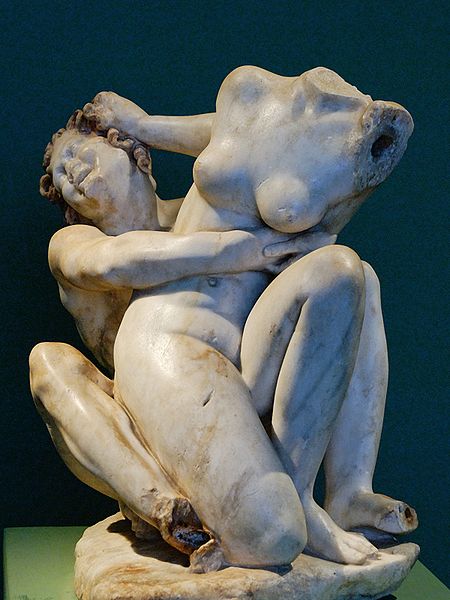 “Satyr raping a nymph”, a sculpture of Roman antiquity.
Abortion
The Greeks and Romans used abortifacient herbs, and performed uterus-scrape abortions. But then, maybe that’s one reason why the Romans had no-fault divorce way back in the 1st Century BC.
Abortion was common in ancient Greece and Rome. Abortifacient herbs have been known since prehistory. Obviously, all of that is far more advanced today than it was in antiquity, but it’s not new. It’s relatively new in the Christian West, but it’s not new in the world.
“There is nothing new under the sun.”
Ecclesiastes 1:9
Abortion and infanticide were both common enough in the early Roman Empire that the Church (and likely the Apostles themselves) felt the need to preach against both of them. (See the Didache.) Both abortion, and infanticide were common among the Greeks and Romans. The Church has been fighting both since its inception.
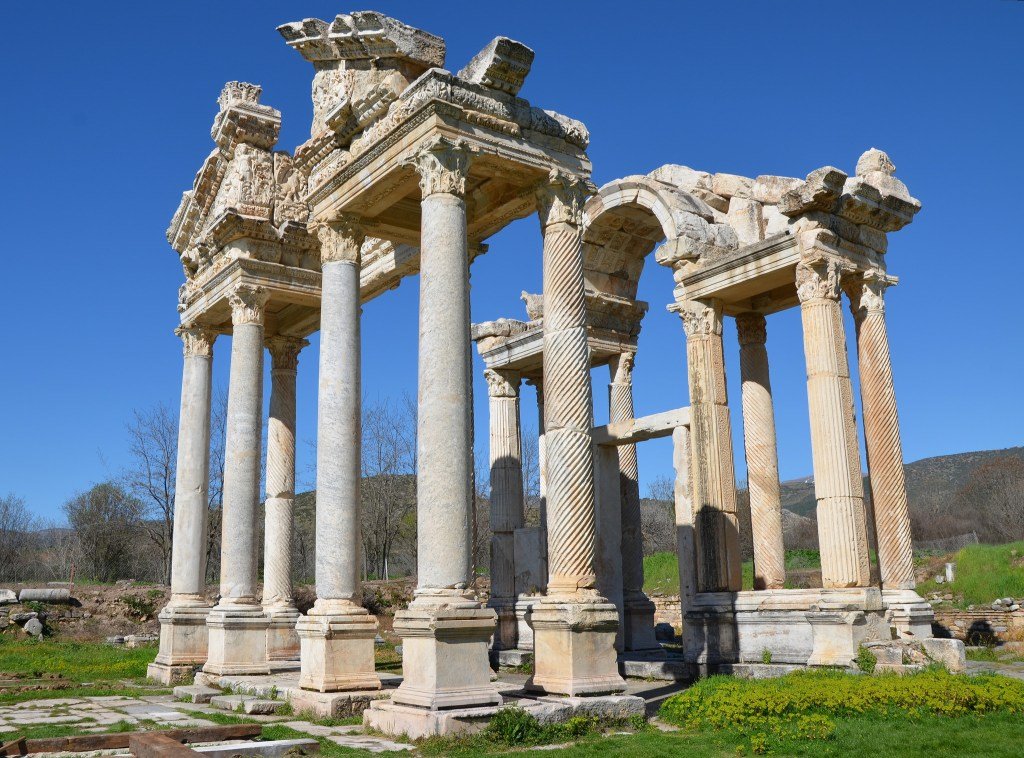 The Roman Tetrapylon of Aphrodisias
Marriage
Greco-Roman culture had its own sex of difficulties but at least it was easy to get married. Marriages were arranged or contracted for economic reasons rather than romantic compatibility.
In Greco-Roman culture women were married early while men were married later in life but were free to sow their wild oats with prostitutes or take advantage of slaves (of either sex). Marriages were in any case either arranged or they were an economic/social contract. That doesn’t resemble our modern dating market at all. There is a book called, The First Sexual Revolution, by Kyle Harper, which goes into detail on Greco-Roman sexual ethics as well as the Christian ethic which replaced it. Both are totally alien to our current cultural view of sex.
All successful religions are elite religions. Christianity provided obedient, virgin wives for the Roman elite. Then the Christian Romans were able to cooperate better than the pagan Romans, so the pagan Romans lost. Then Constantine came in and replaced the official state religion with Christianity and it was all over by then.
The core relationship with the wife was never seen as being based on sexual satisfaction, and so the lack thereof was not a valid reason for upsetting the marriage. This has been changed, and not to the way it was in pagan times, when the paterfamilias had the status that he had in the Roman family — it was changed into a form that did not exist also in Greco-Roman times. The lack of sexual satisfaction on the part of either spouse as a valid reason to dissolve a marriage does not appear until our times — it is new, and it has having a devastating effect.
Divorce
Rome eventually adopted a form of no-fault divorce, but because of the entire social structure, there was not the cultural expectation and pressure inside marriages relating to marital sexual satisfaction being a critical driver of this — and there is no historical evidence that it was. There were likely some Roman aristocratic women who did precisely that, but this did not create a culture in Rome that emphasized sexual satisfaction in marriage — if anything the high degree of tolerance for extra-marital sexual activity for married persons, especially for the paterfamilias (which is contrasted with today, where such activity remains highly scorned socially especially when engaged in by men) would indicate that it was expected that to some degree the marriage would not provide the degree and kind of mutual sexual satisfaction that is expected in many circles today.
 The Les Ferreres Roman Aqueduct is located outside of Tarragona Spain.
H0m0sexuality
Greco-Roman culture was far more sexually immoral than ours. It was so grossly immoral, that the Corinthian Christians didn’t even know that it was wrong for them to have sex with the 1,000 prostitutes of the temple of Aphrodite in Corinth. And yet, St. Paul never told the Corinthians that “some of the biblical laws on sex need to be suspended until conditions improve.” Just the opposite. (See 1st Cor 6:15-20.)
Greek and Roman men used to keep young boys (catamites), whom they would castrate to prevent them from becoming masculine, and use to satisfy their sexual urges (which their wives could not satisfy), because they “placed human sexual satisfaction at the center of their definition of human flourishing”. And there was plenty of lesbian sex, too. None of this is new. See Romans 1.
“Effeminatus” in Latin also had the meaning of “passive/receipient partner in gay sex”. Neither the Greeks nor the Romans were culturally against gay male sex, per se, provided that the male adult (in Greece) or citizen (in Rome) was not an “effeminatus” (i.e., he was the “active” and not the “passive”). (More than you want to know about this is here.)
I think Paul was likely intending to capture not only these and, unlike the ambient Greco-Roman culture, he did not want to draw a moral distinction between “active” and “passive”, so included both “effeminates” and “homosexuals” to make sure it was clear that all participants in gay male sex were clearly covered (and, I would argue, female homosexuals as well) — again, precisely because this was different from what the ambient Greco-Roman culture believed, when it came to “active” role male homosexual activity (passive role activity was viewed as unvirtuous for adults and/or citizens).
NS: Rome also had lots of gay acts, especially among the young, but no “gay identity”. Love and sex were a part of life, not the center, but there were some rules around sex, just not Christianity’s rules. Affection among members of the same sex was common and accepted. Sexuality was also more “fluid”, although perpetual same sex affiliation (to the exclusion of hetero family life) in free adults was shunned and not accepted. Familial loyalty and building up a firm familial foundation was everything, as was playing one’s role in the social order virtuously (as Romans defined it). Rome had its own different set of internal problems and contradictions, but it was, in many ways, similar to the civilization that has persisted in East Asia, albeit in a European vein, which differed based on the underlying philosophical differences between ancient Greek ideas, on the one hand, and ancient Indian and Chinese ideas, on the other.
 A Roman bath house, Bristol (UK).
Spirituality
The Romans had a large panopoly of god and goddesses that are well known today as Roman mythology, with Zeus being the King of the gods and Venus being the god of “love”. Religious practices largely consisted of rituals and a general reverence towards the gods. This pantheology, and the widespread acceptance of the same, allowed all of the societal conditions described above.
The philosophical culture of Roman antiquity had a wider and much more pervasive influence in the socio-spiritual realm, building on Greek topics such as political equality, political rights, authority, tyranny, free citizenry, the influence of superpowers, and a national republic.
During the time of the earliest church there remained a great cultural influence from Greek philosophical schools, principally of three variants: (1) neo-Platonic Gnosticism, (2) Stoicism, and (3) Cynicism (as defined philosophically, which is very different from the contemporary uses of the words “stoic” and “cynic”) in the ambient culture, and even while the early church fathers railed against Gnosticism, Stoicism, and Cynicism, that was mainly because that thinking was widespread in their churches, because it was the prevalent thinking in the ambient intellectual culture of late Rome.
Christianity was introduced precisely at the zenith of Roman power and influence, and this is how Christianity came to be spread across the civilized world so quickly.
One of the immediate impacts of Christianity is that it upset that apple cart of Venusian “love” and rampant fornication, because Christianity had absolute rules about sex, no matter what stage in life, and absolute rules about gender expression as it relates to sex, just as the Hebrews did. There was a major culture clash between the Greco-Roman ancient culture, which in many ways is more similar to what persisted in China, and the Hebrew one, but via Christianity the Hebrew vision prevailed and “alternative sexualities” were suppressed, filial piety was chipped away at over time and replaced with absolute loyalty to God, the “virtuous life” (key in both the Roman and Confucian systems) was replaced with Christianity’s vision of holiness through grace and standards which are not achievable by human effort (contra Rome and China). The entire order was turned on its head rather deliberately.
“25 …they exchanged the truth about God for a lie and worshiped and served the creature rather than the Creator, who is blessed forever! Amen. 26 For this reason God gave them up to dishonorable passions. For their women exchanged natural relations for those that are contrary to nature; 27 and the men likewise gave up natural relations with women and were consumed with passion for one another, men committing shameless acts with men and receiving in themselves the due penalty for their error. 28 And since they did not see fit to acknowledge God, God gave them up to a debased mind to do what ought not to be done.”
Romans 1:25 (ESV)
The Roman Empire essentially crumbled from within as it reached peak decadence, which followed a long period of prosperity and power. In other words, in that case God’s judgment (since the rise and fall of all empires is according to His schedule) looked like more like Romans 1 than Genesis 19.
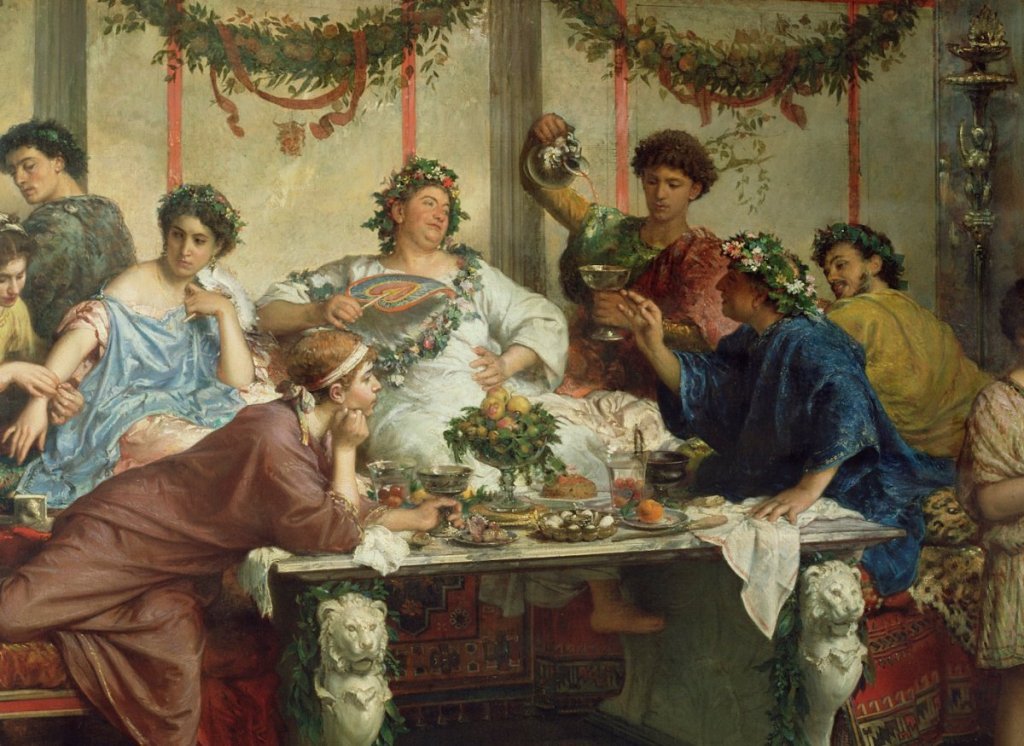 A Roman Feast, by Roberto Bompiani (1900).
The Historical Influence of Roman Culture
The entire western culture is built on an amalgamation of Greco-Roman-Gothic values that have been whitewashed with a veneer of Christian values.
Feminine superiority is a major element in the element of Germanic mythology that was absorbed, in parts, into Western culture through the contact between the Germanic gothic tribes and the Romans. That’s where a good deal of the much more prominent devotion to Mary in the Western Church (as compared to Eastern Christianity) stems from; women dominated that society in ways that aren’t noted often in history studies. For example, the weregild for a woman was twice that of a man in the same social class, because women were more valuable than were men, due to having the rarer reproductive resource. Later, concepts like chivalry and courtly love were integrated into Western culture approximately 800 to 900 years ago, of course, long before contemporary feminism.
These elements were incorporated into Western culture in roughly the same process. The influences of Christianity and the influences of folk religions were an ambient part of Western culture, and there occurred a blending of both of the elements together in terms of the mind, mindset and identity of the average Christian. Even though the Church itself never explicitly endorsed Chivalry and Courtly Love as doctrine (that is, until the advent of Churchianity), the average Christian growing up in this culture had these ideas impressed on their mind, their mindset, and their identity, and saw that as being merged with their “Christian” identity as well. Thus, these pagan influences came into the church “through the back door” by means of a de facto cultural merger on the personal level.
I would argue that “Christianity” as it evolved once embraced by the elites of the Roman Empire, was destined to bring us to exactly where are today.
Dalrock has shown that the anglo West is just emerging from a thousand years under sway of the Romantic Tradition as evidenced by chivalry and its long tail influence in male/female relations. The majority of people, at least in America, are much influenced by Romanticism and Romantic expectations. The “conservative”/tradcon Right has staked-out Romanticism as the ethical and spiritual foundation of their lives. Romanticism even rules their churches, because it’s a female-supremacist system.
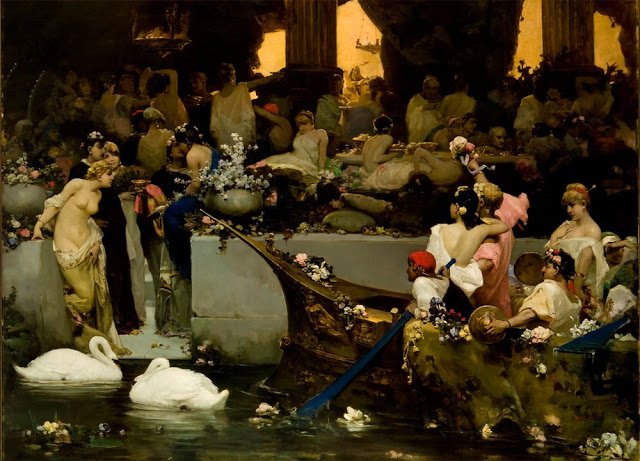
The Modified Continuation of Romanesque Pantheism
The trouble in the West is that in the post-post-post enlightenment phase that we live in, we are now neither fish nor fowl. The Christian replacement of Roman virtue with its own values has been abandoned by many, and soon by almost all. The emergent world, however, isn’t really a reification of the pre-Christian system and its esteem for virtue (as exemplified in, say, the writings of Marcus Aurelius or even Seneca), as much as some Christians like to say that it is — would that it were so, really.
No, we are replacing the prior Western systems — Greco-Roman and then Hebrew/Christian, the combination of Athens, Rome and Jerusalem that made the West itself — with …. nothing. Nihil. That is the problem.
The “drafters” of the contemporary “vision” are anti-vision: the idea is for everyone to make his/her/its own vision, with no cohesion — nether the Greco-Roman one, nor the Christian one, nor the Confucian one, etc. Rather it’s Novaseeker’s vision for Novaseeker, Jack’s vision for Jack. There is no cohesion. Would that we were simply repaganizing — as Christians we could deal with that, because we’ve had the argument with pagan philosophy already — we know how to engage that adversary. We are having a much harder time, however, with the new and different challenge that is facing us, a challenge that wasn’t presented to the Christians who were dealing with the world of Greco-Roman paganism.
It’s a natural cultural cycle for a society trying to ‘outsmart’ God and his Word, and not just for Christian cultures. Romans 1 says that “Professing to be wise, they became fools” (v. 22). Even pagans know what God wants them to do, because God has written His law in their hearts (Rom. 2:15), and revealed His nature through them through nature itself (Rom. 1:18-21).
That’s why even pagan cultures often arrive at conclusions found in the Bible, even though they never read the Bible, often times before the Bible was even written.
Cultures discover God’s will either by reading the Bible, or by generations of painful trial and error (sometimes both), but eventually a generation comes along that thinks they know better.
Jesus tells us in Matthew 19 that God intended from the beginning (quoting Genesis 1-2) for human sexuality to be confined to marriage, which Jesus, quoting Genesis 1-2, defined as a union of one man to one woman for life.
But, every generation since the Boomers knows better, right? We know that heterosexual promiscuity is better. In fact, it empowers women. So do birth control pills and abortions.
Oh, and homosexual promiscuity is even better.
Oh, and transgenderism is even better.
What’s next? Pretty much all the depravity in Leviticus 18.
Buckle up. It’s going to be bumpy ride.
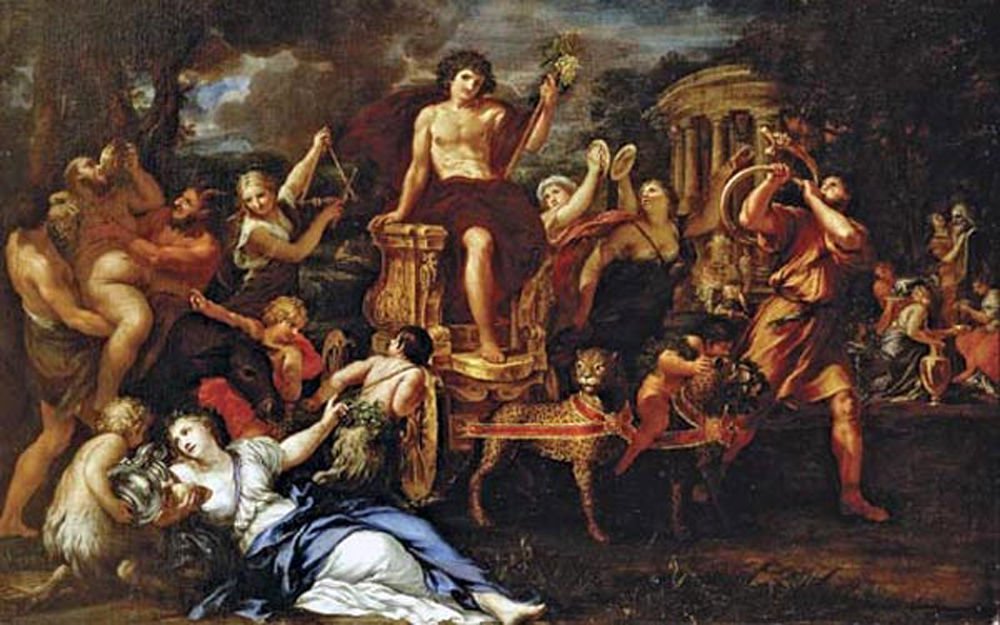 The Triumph of Bacchus, by Ciro Ferri (ca. 1668).
Conclusions
In the end, the legacy of the Roman Empire in our contemporary world is mixed and complex. Some elements of our culture are traceable to the ancient Greco-Roman heritage, while others are Christian in origin. Still others arose due to the “bringing back” of some of the ideas of the Greco-Roman era during the Renaissance and the working out of those ideas, and their expansion, in during the “Enlightenment“, which created a new synthesis: a kind of “Nouveau Greco-Roman Revivalism with a Christian Base” … which itself has now collapsed on itself due to the rise of a skeptical attitude towards reason itself in the wake of the 20th Century and the advent of Post-modernism.
However, because of the importance of the Greco-Roman “piece of the puzzle”, its legacy will always be controversial and, for Christians, the history of the confrontation with Roman paganism 1500 years ago will always be formative.
Related
- Ancient Origins (Riley Winters): The Roman god Bacchus as a Christian icon (2014 October 21)
- Σ Frame (Jack): Moon Day Review – The Feminine Empire (2019 May 6)
- Σ Frame (Jack): Progressive (2020 November 10)
- Σ Frame (Novaseeker): The Amalgamation of Western Culture (2020 December 2)
- NATSAB (Pete Rambo): Interesting quote from the Theological Dictionary of the New Testament (2021 May 27)
