
Simple yet great examples of true masculinity.
Readership: All
Theme: Honoring Fathers
Author’s Note: This essay was written on 2023/2/4.
Length: 1,250 words
Reading Time: 6 minutes
Honor is Denied to the Common Man
In the comments section of Jack’s article, Are Men Responsible for Women’s Behavior? (2023/2/1), I linked to a Substack article by The Fiamengo File called The Henpecked Hero. I’ll excerpt it here, but I encourage the reader to read the whole thing.
“But why is she disappointed at all? The question of the woman or girl’s anger arises and is never answered in any of these programs. Are we to condemn the man because he didn’t grovel harder with an emotionally volatile woman? Because he didn’t compromise his professional obligations? Because he is so dedicated to his demanding and often dangerous job that he is emotionally spent when he comes home — or because what he deals with is so brutal that he can’t talk about it? So often in these scenes of castigation, one is struck by the ludicrous inappropriateness of it all. How dare this girl berate her father? How dare this woman debase her man? And why does he put up with it?”
The article details a common trope in modern entertainment that we’ve all seen a thousand times. A heroic man who – although flawed – is obviously worthy of respect and admiration and receives both from the men around him, but never from the woman (or women) he loves most. From his women (typically a wife, ex-wife, girlfriend, ex-girlfriend, and/or daughter) he receives nothing but contempt, disrespect, or even disgust.
Many men have experienced this dynamic in real life, which makes me wonder if this is a case of art imitating life, or life imitating art.
We know that popular culture greatly effects the way people think and therefore behave, so we don’t want our children or wives to indulge in entertainment that encourages this behavior. Besides, who wants to watch another good man be humiliated this way?
Honor Showcased
Fortunately, there are examples of popular entertainment that honor husbands and fathers.
This article is the first in a series that will highlight popular entertainment from the year 2000 and later that honors fathers and husbands. I encourage readers to add examples of their own.
As we’ll see later in the series, documentaries and movies that are based on true stories are more likely than fictional movies to honor fathers. That’s because in real life, fathers aren’t the incompetent, impotent imbeciles commonly portrayed in modern popular culture.
We’ll start with my favorite example, a BBC documentary called Human Planet.
Human Planet is a 2011, 8-part BBC documentary originally narrated by the legendary David Attenborough. Every documentary of his I’ve watched is about animals or plants, but this one is different. Here, the BBC shows us how people from vastly different cultures all over the world live. In so doing, the BBC ends up telling compelling stories about the extraordinary things fathers do to support their families. Because it’s a documentary, and because it didn’t set out to portray fathers heroically, Human Planet sets the difference between real life and Hollywood indoctrination in even starker contrast. I assume this is inadvertent, but that makes the documentary even better.
Human Planet used to be on Netflix, but these days it’s tough to find on any streaming service. I was able to find a lot of it on YouTube, though. You’ll have to hunt this one down to watch the whole thing, but I assure you it’s worth the effort.
Without further ado, let’s look at my favorite story.
Sailau and Berek
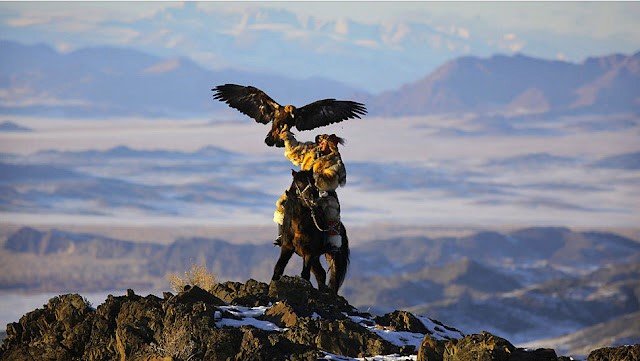
Sailau belongs to a Kazakh tribe who traditionally use golden eagles to hunt foxes. His family needs fox furs to stay warm through the brutal winter. Sailau trains his son, Berek, in the art of falconry, beginning with capturing a fledgling female (they’re bigger than the males), then training her, then taking her on her first hunt. The best part is when Berek and his eagle make their first kill. Sailau tells his son, “Now you are a man of your people”. The look on Berek’s face is absolutely priceless.
Stanzin
Stanzin and his family live in a remote Himalayan village. He wants his children to receive an education, but there are no schools in his village, so Stanzin takes his children to a boarding school 100 Km away. It’s a serpentine six-day trek over the frozen (but thawing) Zanskar River, elaborated by freezing temperatures, high winds, and treacherous avalanches.
Sam Niang
Sam Niang risks his life every day to feed his family of seven. The roiling rapids of the Mekong River trap migrating fish, but to net them, Sam Niang has to climb wet, mossy cliffs and traverse the Mekong on a makeshift bridge he jury rigged together in the dry season.
Tete
Tete also risks his life for his family, but in his case it’s by climbing 130 ft up a tree with no safety gear and suffering dozens of bee stings to score some honey for his wife and children.
Tete’s wife has some great lines.
“Tete is the best. The kids are not afraid for him, just proud. They say, “Wow! Look at dad!”… My husband has a kind heart. He always brings me honey.”
The narrator, though, gets the best line.
“Tete takes time to savor his success. He’s done enough to keep his wife sweet, treat his children and earn respect from his tribe.”
Isn’t that what all married fathers want?
Hatogo and Sulaiman
I’ve observed good men work themselves into an early grave to support their families, but nothing quite like this. In the Indonesian island of Java, men mine sulfur in the Ljen Volcano’s crater. The gasses that constantly fill the crater, including Hydrogen Sulfide (H2S), are highly toxic, and even if they don’t kill the men right away, they destroy their lungs over time. On top of that, carrying 90 kg (about 200 lb) of sulfur at a time in baskets leaves their shoulders scarred, calloused and deformed.
All for $5.00/load!
One of them states:
“They say this job can shorten your life. I do it to feed my family. No other job pays this well.”
But that’s what dads do. They sacrifice themselves for their families.
Concluding Statements
Human Planet contains many more stories. Not all of them are about dads, but most are. The documentary is beautifully shot, entertaining and educational, but what I love most about it is the stories of dads from wildly different cultures who are remarkably alike. They all want to provide for their families and earn their peers’ respect. That theme is so nearly universal that it’s almost as though someone designed it that way.
I shouldn’t be surprised anymore when I see God’s plan naturally bubble to the top through layer upon layer of human sin, but for some reason I still am. I doubt that any of the men whose stories I highlighted have ever heard the Gospel, but they all bring to my mind passages from the New Testament.
14 Indeed, when Gentiles, who do not have the law, do by nature things required by the law, they are a law for themselves, even though they do not have the law. 15 They show that the requirements of the law are written on their hearts, their consciences also bearing witness, and their thoughts sometimes accusing them and at other times even defending them.
Romans 2:14-15 (ESV)
Having never read the book of Ephesians, these married fathers nevertheless love their wives and children sacrificially. My experience and observation tell me that is the rule, not the exception, among married fathers, and for that we should honor them.
Related
- Σ Frame: Epilogue: Counting the Cost (2022/3/30)
- Catacomb Resident: Want to Exercise? (2023/6/25)
- Catacomb Resident: Dire Need for Manhood (2023/6/26)
