
Exposing the Lies about Women’s Fertility Window.
Readership: All
Theme: Validation
Note: This post expands a previous comment with some updated information.
Length: 1,800 words
Reading Time: 10 minutes
Intro
There is a widespread but FALSE belief that women can get pregnant up until around age 40, with 35 being seen as the “fertility cliff”. So, a lot of women get the erroneous notion that the “right time” to have children is between 27 and 35.
Everything you’ll find on the internet supports this belief. Even the U.S. National Institute of Health will tell you…
“When a woman is younger than 30, she has an 85% chance to conceive within 1 year. At the age of 30, there is a 75% chance to conceive in the first 12 months. This chance declines to 66% at the age of 35 and 44% at the age of 40.” [1]
To put this into perspective, if you had cancer and the doctor gave you a 66% chance of recovery, you’d be putting your will in order. But women feel no compunction about giving their child a 66% chance to live by waiting until their mid 30s.
So instead, everyone is doing mental gymnastics to deny the fact that the prime fertility window is much earlier, between ~14 to 26 years of age.
Another peripheral deception of this LIE is that most people believe that menopause, usually regarded as the cessation of menstruation, is a good indicator of when a woman’s fertility window has closed. But this is a FALSE indicator. Menopause and amenorrhea can occur looong after a woman’s robust reproductive functionality has ceased (up to ~10 years).
Don’t believe me?
What is the Truth?
We get a more accurate concept of real fertility when we look at the age specific fertility rates over time…
In the U.S.:
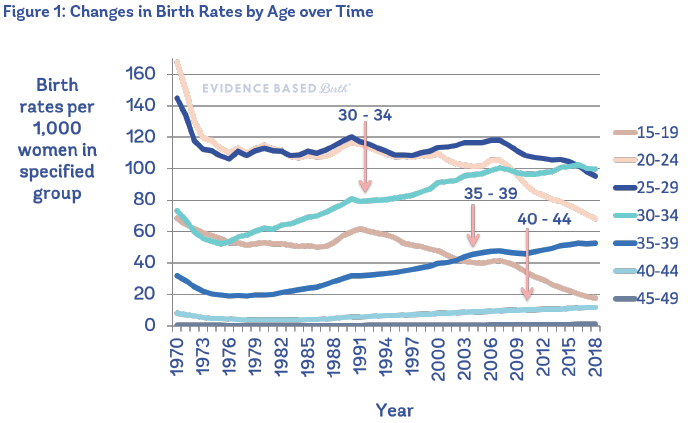 Image Source.
 In England and Wales:
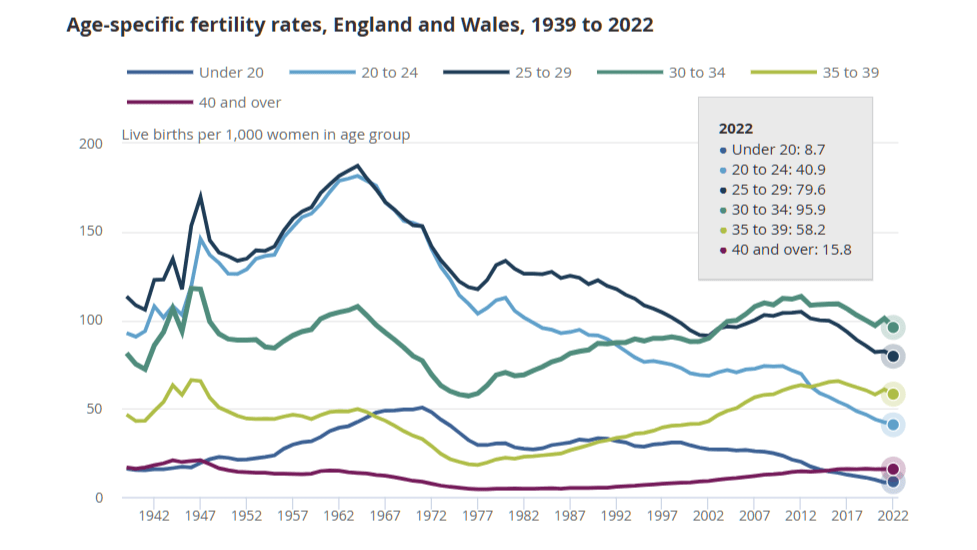 Image Source.
 When we look at fertility rates before Women’s Liberation in the 1970s, clearly, women in their 20s were (and still are) the most fertile.
Another factoid: Women who’ve already had children when they were young are MORE likely to get pregnant after 30. This explains why so many women living before Birth Control was introduced in 1960 continued to have children well into their 30s. OTOH, women who are promiscuous (i.e. contract STDs, which mess up the reproductive organs) and/or have abortions are much LESS likely to have a geriatric pregnancy. This certainly contributed to the decrease after 1960 (and still does).
But since then, it’s gotten wanky.
InVitro Fertilization (IVF), using donor sperm (“sperm banks”) and donor eggs (“test tube babies”) came along in 1978, leading to an uptick for the 30-34 group. Then women decided they could wait a little longer to have children.
Assisted Reproductive Technology (ART), using a cocktail of fertility drugs, became popular during the mid to late 80s, leading to an increase for the 35-39 group. Then women decided they could wait a little while longer to have children.
Look at the numbers of women having children via IVF.
- One out of every 42 babies born in the U.S. in 2021 was conceived using IVF or other assisted reproductive technology.
- An average of one out of every 50 babies born in Europe [2].
- One in every 18 babies in Australia were born through IVF in 2021.
- One in every 15 babies in Taiwan were born through IVF in 2024.
But when we look at the success rate of IVF, we see that even medical ¡ScIeNcE! has limitations.
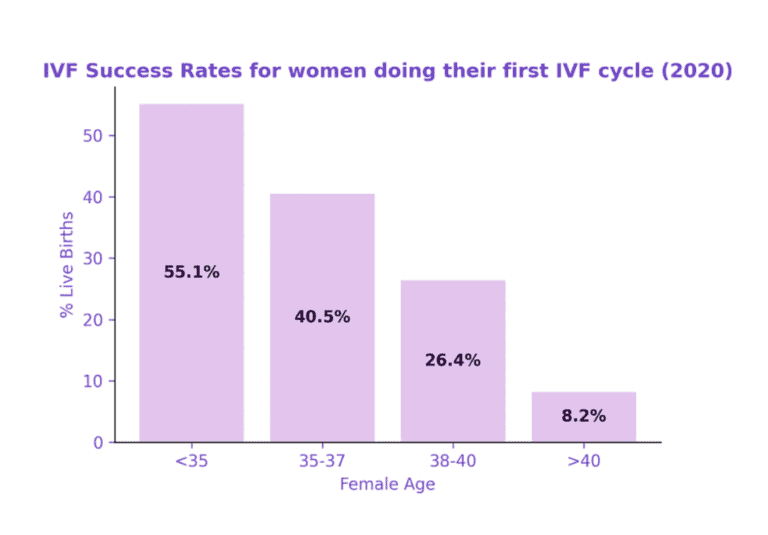 Image Source.
 All this information is presented in a false positive vain of “LOOK WHAT WE CAN DO! Now you can postpone childbirth until middle age!”
It is never presented as “Look at all the cutting-edge medical technology and $$$ that is required just to give you a slim chance to make up for wasting your prime years of fertility on your career and riding the carousel!”
The Consequences
So now we have an epidemic of women who are working hard to advance their careers in their 20s so that they can earn the $$$ needed to pay for fertility treatments in their 30s, and to support themselves in their old age when that fails.
This LIE is why we now have a trend of women freezing their eggs and spending big $$$ at fertility clinics, often to no avail.

Case Study 1 — The Frustration of Ob-Gyn Doctors
Here’s an example of how much trouble this LIE is causing everyone — not only women who vainly hope to have their first child at the ripe old age of 30+, but also ob-gyn doctors.
Slate (W. Spencer McClelland): Age 35 Isn’t a Fertility Cliff. Why Do We Think It Is? (2020/8/17)
McClelland is the lead physician for Women’s Care at the Denver Health Clinic, and an assistant professor of obstetrics and gynecology at the University of Colorado.
Similar to Rachel Hislop’s piece, in this exposition, McClelland offers another catharsis aimed at post-carousel riders lamenting the difficulty of having children — but unlike Hislop’s fine whine, McClelland’s exposition is laced with a bit of truth.
Physicians use the term ‘geriatric’ to describe women’s fertility above their early 30s. This is the typical age when women’s reproductive organs no longer function normally and/or the genetic quality of their eggs gets wanky. But McClelland says the current estimate of advanced maternal age is younger than what everyone thinks — it’s 32.5 years, NOT 35 as was estimated decades ago. He says, in so many tortuous words intended as a kindness and also as a warning, that a fertility specialist or obstetrician is NOT a god who can forgive a woman’s self-centered ignorance of postponing childbearing. If a woman has waited this long, it may be too late.
Bwana Simba quipped,
“Any old school pre-C0V!D doctors trying to explain to a hysterical white woman that her fertile years are gone must be questioning their career choice.”
Heh. Well, at least they’re earning a living off these Working Girls. Quite the switcheree!

Case Study 2 — Fecundity Fraud
This ought to be common sense, but apparently, common sense is truant. Here’s the lesson they missed while they were playing hooker hooky.
A woman’s fertility only lasts for a limited time. It has an expiration date. The MORE time a woman spends NOT having children during her fertility window, the LESS time she has remaining to have children, and the fewer children she will have.
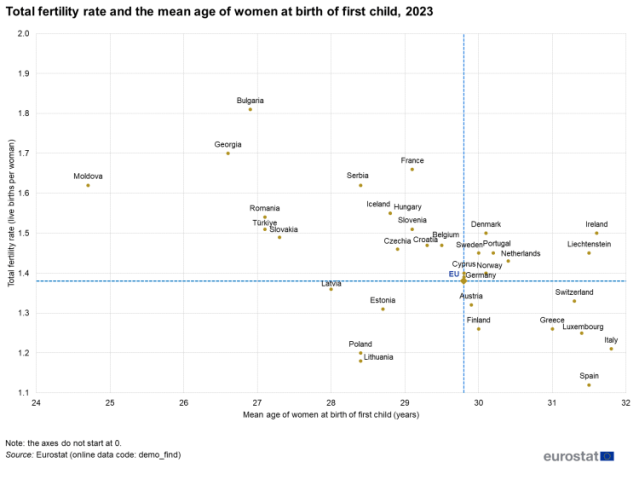 Image Source.
 Furthermore, when women choose to postpone marriage and children for whatever reason, whether it be to pursue an education and career, or to travel, or to enjoy her penis sampling ‘Season of Singleness’, or … as Dalrock famously quipped, She wants 2.3 more years of sex with other men before she settles for you. (2017/10/2), they are unwittingly robbing their future husbands of the opportunity to have (more) children.
Men fall for this ruse too, when they marry a woman who’s at the upper limit of her fertility window, which is the grand majority of men these days, as women’s average age of marriage is 27.4 now 28.6 and rising fast. They swallow the LIE in thinking she still has a few good years of child-bearing left — when actually she doesn’t. So then they have fewer children or none at all, or else they end up blowing big $$$ at fertility clinics with little hope of success.
Worse, many women have already reached a state of infertility and don’t even know it.
Like what Bwana Simba told us,
“At age 29, 90 percent of a woman’s eggs are gone. I have known a number of couples where the women remained into their thirties to have kids, only to be shocked to discover they have fertility issues because of it.”
Or worse still, due to her time making her rounds on the Carousel, a woman might have picked up a pesky STD that cuts her fertility window shorter than average. (For example, chlamydia causes scarring in the fallopian tubes which can totally and irreversibly arrest a woman’s natural fertility.) But I repeat myself.
Worse yet, some diseases can escape detection, and still exact a toll on a woman’s reproductive system.
Even worse, because of all the medications available to treat such diseases, she’s able to entirely hide this hard hit to her heathery hearth.
(BTW, if a woman has a history of STDs, some of these can be indicated by the presence of specific antibodies for that disease, e.g. chlamydia.)
Worst of all, some diseases have the potential to be passed on to her stand-in ‘husband’ … and to the children.

Summary
To summarize, let’s spell out the female fertility window in terms of an eight-phase timeline.
- A woman’s fertility begins at puberty. If she’s menstruating, she can pop out kids.
- Fertility peaks at ages 17-23.
- Ages 23-26 are prime homemaking and childrearing years.
- Age 26 is the fertility cliff.
- Age 29 is when that door is closing.
- Age 32.5 is geriatric, in terms of procreation.
- A pregnancy at any age above 32.5 is an anomaly (unless she’s had a history of bearing children earlier in life).
- Sometime later … Amenorrhea and Menopause
Adding to this awareness, Men hoping to be fathers should learn to read the obvious signs. This should also be obvious, but it is seldom mentioned.
The Wall not only indicates that a woman is past her expiration date in terms of her sexual desirability, but also in terms of her fecundity as well. IOW, don’t expect post-Wall pumpkins to become preggo. If it ever happens, it’s a miracle of God (or ¡$c!eNcE!).
If she’s young and hot, she’ll bear a tot. If she’s past the Wall, her legacy is null.
Don’t let Pumpkin Pies tell you LIES otherwise, cutting your progeny down in size.
Apex SMV = Prime Fecundity
Read it well, and remember. Thus the Lord saith.

Conclusions
All in all, fertility is a fragile gift bestowed upon women as the weaker sex, and there are many factors that can hasten the demise of a woman’s peritoneal baby factory, time being of the essence. Even if wives don’t knowingly defraud their husbands, men can still experience fecundity fraud simply by believing the LIE and marrying a ‘geriatric’ wife. Trying to make up for this foolishness can be pricey and unsuccessful.
What I wrote about The Abortion Bottleneck also applies to women postporning marriage and children. Women who do not prioritize marriage and children early in life are self-selecting themselves out of the gene pool. And their ‘husband’s’ too.
The Lord’s judgment on a life well wasted.
References
- Delbaere, I., Verbiest, S., & Tydén, T. (2020). Knowledge about the impact of age on fertility: a brief review. Upsala journal of medical sciences, 125(2), 167–174. https://doi.org/10.1080/03009734.2019.1707913
- Dobson R. (2006). Proportion of babies born in Europe after IVF varies 20-fold. BMJ : British Medical Journal, 332(7542), 626.
Related
- Chateau Heartiste: The Wall (2010/2/1)
- Dalrock: Losing control of the narrative. (2012/8/11)
- Dalrock: Debasing marriage. (2012/10/7)
- Σ Frame (Lexet): Theories on Single Women in the Church (2020/12/5)
- Σ Frame: The Feminist Life Script (2020/12/17)
- Σ Frame: Average age of first time sexual experience (data) and what this means for Christians (2020/12/20)
- Σ Frame (Thedeti): The more things change, the more they stay the same. (2022/2/28)
- Eurostat: Fertility Statistics (2025/2)
- The Rational Male: Why are Women Freezing their Eggs? (2025/6/3)
