
Women have limited agency in any social structure — except Christianity.
Readership: All;
Theme: Awareness and Introspection
Length: 2,400 words
Reading Time: 13 minutes
Intro
Back when I tackled the slippery question of female agency in late 2022, I invited fellow blogger Derek L. Ramsey to write an exposition on his take on this subject. He did write not one, but several posts on this topic, but he did not address the outstanding question of whether women have agency or not, and why he believes so. Instead, he dismissed the question as a false binary.*
Recently, however, DLR wrote a more satisfactory answer to the above question in his post, Limited Agency (2025/8/4). At 4,800+ words, this essay is rather long and difficult to follow, so here, I’ll extract his key points and summarize his main arguments in less than half the number of words.
* Although DLR is technically correct in saying that the question assumes a false binary (agency is better understood as a distribution of individual capability, as Zippy Catholic described), he effectively sidestepped the question and thus failed to offer anything substantial to the discussion, nor to our understanding of this subject.

Women have de facto Limited Agency
In this essay, DLR argues that women universally have de facto limited agency across all societies, historical and modern, regardless of whether they operate under feminist or patriarchal systems.
He regards Feminism and Patriarchy as two diametric constructs of how societies deal with the fact that women as a sex possess lesser agency than men. In effect, the principle of limited female agency is clearly demonstrated in both social systems, but manifests quite differently in each one.
For example…
In Patriarchal societies:
- Women’s achievements are cherished and celebrated — because of women’s limited agency.
- Men take responsibility for women — because of women’s limited agency.
- A woman’s vows (including the decision to have sex/marry) are subject to later revision by her father — because of women’s limited agency.
- R@pe is “allowed” [sic.], and complicit women are blamed for tempting men and/or being too meretricious — because of women’s limited agency.
In Feminist societies:
- Women’s achievements are emphasized and fabricated — because of women’s limited agency.
- The state takes responsibility for women — because of women’s limited agency.
- A woman’s decisions are continually subject to her own revision — because of women’s limited agency.
- R@pe is universally condemned, including charges fueled by in situ consent followed by post-hoc regret [example], and complicit men are blamed — because of women’s limited agency.
But in all cases for both systems, whether feminist or patriarchal, limited female agency is the governing principle. Therefore, in both systems, there are societal expectations that men bear greater responsibility and are consistently held to higher standards and stricter accountability, while women are usually excused or shielded from equivalent consequences for comparable behaviors. DLR goes further to state that for either of these two social systems considered, men will always be held to a different and higher standard than women because society will always deign women to have lesser or limited agency.
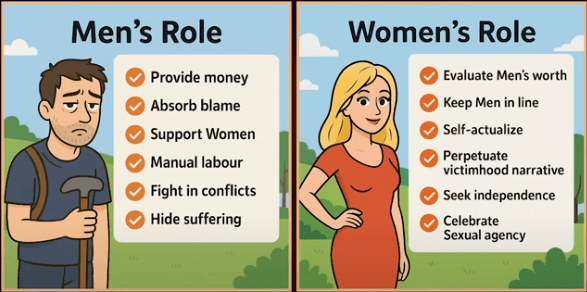
Equal Agency is a Platitude Held by the Disaffected
DLR critiques the notion of Equal Agency, asserting that no society, except perhaps an idealized egalitarian Christian framework, grants women full agency comparable to men. In support of this assertion, he discusses examples like social and legal biases in favor of women, pervasive double standards that always favor women, and how “post hoc regret” after consent constitutes r@pe.
Moreover, DLR posits that the very notion of Equal Agency is an idealistic platitude arising from the widespread discontent resulting from the perceived failures of whichever system is in place.
To wit:
- In the context of Patriarchy, women who are disadvantaged, or discontented, or unloved, pine for equal power, authority, and status with men, or else greater independence from men.
- In the context of Feminism, disaffected men demand that women should be more responsible, contribute to society, offer value to men, and pull their own weight.
On this point, DLR concluded [expanded for clarity],
“Where the discomfort comes is not in the fact that women have limited agency, but in how that limited agency is implemented (e.g. feminism vs. patriarchy vs. some other system). But, and this is key, just because your preferred culture isn’t the one in charge (e.g. patriarchy; husband rule) [changing to that preferred structure] does not mean that the inherent instinct for limited female agency magically goes away. It does not. In [either a patriarchal or] a feminist society, women have the same limited agency, but now it’s within a completely different framework, like the one in the picture above.
What most dissatisfied people want is just a different system of limited agency, not equality. You can’t fix the current culture by trying to give women more equal agency, by insisting that they utilize agency more fully. That’s not how it works, and it never will. Men cannot magically cause women to have greater agency, they can only change the system in which limited female agency operates.
Thus, if feminism is ever overthrown—and the feminist version of limited agency with it—it will be replaced by another system of limited female agency (e.g. Islam), not a system of equal agency.”
Note: The line in bold above is the point of difference that sets DLR at odds with the Dalrockian segment of the Christian Manosphere, which sees men as partly responsible for instilling agency in women (and children) under their care by holding them accountable. (More on this below.)

Christianity Assumes Female Agency
DLR cites a comment from Cill at Spawny’s Space to postulate that accountability invites reciprocity, which in turn implies equality.
Standards → Accountability → Reciprocity → Equality
But ONLY within a Christian context.
Outside of this context, and in contrast…
- In a patriarchal system, men choose to be responsible for women in their domain because of assumed male dominance, and because women have limited agency compared to men.
- In a feminist system, men are held accountable by women because of presumed female superiority, despite women having limited agency, compared to men.
Neither has true Equality.
On this point, DLR concludes,
“Outside of an explicitly Christian context and an explicitly Christian marriage—and one that explicitly rejects Old Testament patriarchy and the Curse of Eve from the Fall of Man—there is little chance that men and women will ever have equal agency. The secular culture simply will not allow it. It’s best to get used to that fact and adjust accordingly.”
DLR states that Christianity is unpopular and won’t ever work in a non-Christian / secular society because Agency is anathema to the female fleshly nature, and Christianity encourages women to develop and to regularly instantiate agency.
DLR does not explain how Cill’s process should work in a Christian context. But the answer is that Christian men need to initiate the process outlined by Cill by imposing boundaries and standards, and holding accountable those women who are under their domain of authority. Judging by his other comments and writings around the sphere, DLR seems to be deeply uncomfortable with this practice.

AWALT, Even Christian Wives
In spite of all the arguments conveyed above, DLR dedicated a fair amount of his essay to dispel the notion that women should provide value to men, based on his central claim that women lack the necessary agency to do so.
The reality of this is undeniably evident, he says, even though women are ordained by God to be men’s ‘helpers’ (Genesis 2:18, which applies to both Christians and non-believers), and apparently, he includes Christian women who are supposed to possess greater agency, as per his own argument (described in the previous section).
DLR goes further in this essay and also in other comments around the sphere to state that it is unreasonable for Christian men to expect their presumably Christian (but perhaps de facto feminist) wives to act agentically and/or provide value to their marriage, even though Christian women are supposed to possess greater agency, as per his own argument (described in the previous section).
“If you happen to be a proponent of patriarchy, headship, or feminism, you believe that men have greater agency than women and should not complain when society assigns limited agency to women. It is hypocritical.”
DLR has stated similar platitudes repetitively to many Christian men in the sphere who are married to difficult wives, thereby receiving derision as a troll.
As a preemptive deflection of criticism, he also devoted a fair bit of his essay to argue that calling on men to step up in response to women’s limited agency is NOT the same as demanding men to “Man UP!” … because (1) he is not a blank slatist, (2) we are not living in a patriarchy, and (3) it is men’s duty to protect and provide. He forgot to add that it is our duty as men to suffer and die for our wives.

Contextual Quibbles
DLR criticizes the classic Christian Manosphere author, Dalrock, and his philosophical adherents, for asserting that women have (or can / should have) full agency, arguing that this notion conflicts with observed cultural (i.e. secular) norms and practices, and asserts that assuming or enforcing equal agency is futile outside a specifically Christian context.
However, DLR fails to acknowledge that Dalrock’s writings address women’s agency specifically within a Christian context, and that in this, DLR appears to agree with Dalrock’s stance that Christian women have (or are capable of having) a larger degree of agency.
Overall, it appears that DLR disagrees with the Dalrockian Biblical assertion that Christian Headship Authority (a form of Patriarchy which assumes limited female agency) should be the preferred social structure for lay Christians, instead favoring his version of a more egalitarian-ish framework, Peaceful Unity, which assumes female free agency per his idealized concept of Christianity.
OTOH, despite DLR’s apparent endorsement of his nuanced brand of egalitarianism, he is rue to identify as egalitarian because of the doctrinal compromises made by mainstream Christian egalitarianists, as Dalrock made evident in a multitude of posts.
DLR doesn’t explain how his version of egalitarianism should work out in the case of lackluster female agency in a Christian context, even though he has been asked to do so many times. Perhaps his reticence is because the practical answer looks something like Jack’s approach or TheDeti’s approach, both of which DLR passionately despises and therefore rejects as viable options. This is apparently why DLR refuses to name TheDeti, even when citing his quotes, referring to him instead as “Pesudonymous Commenter” [sic.], and why he does not allow pingbacks to the blogs and comments that he cites in his writings.

Jack’s Commentary
DLR stated,
“No society has ever agreed that women have full agency compared to men. None. Not a single one. Society is behaving 100% rationally — per its own standards — when it demands that men [or the state] take full responsibility for females. This is essential to both feminism and patriarchy (including the Christian headship model). Outside of Christ, there is no reason at all to grant full agency to women, and no one does.”
“No one does” … except most of the current Manosphere 2.0, which is doing a pretty good job at pointing out how both society and women are 100% irrational, and they’ll even throw in a Biblical citation now and then. Nowadays, if you look at all the arguments in the current Red Pill content (e.g. this video from Alexander Grace), you’ll see that this is now a basic assumption — that women should have, and often do have agency, and if they don’t, then they’re stupid dufuses that no self-respecting man would ever want to own.
For marrieds, recall my earlier assertion that Headship Authority and Game are more appropriate for relationships in which the wife is spiritually immature and lacks agency.
Moreover, DLR’s has a shaky concept of why female submission is important to a Christian marriage.
Despite all these assertions that ONLY Christian women could possibly have any semblance of agency while non-Christian women do NOT, DLR appears to deny the possibility that Christian women can and should exercise agency via submitting to their male Head, as stipulated in scripture (Genesis 2:18-25, Genesis 3:16, 1 Corinthians 11:3, Ephesians 5:22-23, Colossians 3:18, 1 Timothy 2:9-15, Titus 2:3-5, 1 Peter 3:1-6, 1 Peter 5-6), instead intimating that Christian women are only obedient because of some Invisible Magic Authority (which I would assume is the Holy Spirit in his mental model). Having a faithful wife has rendered DLR ignorant of the fact that husbands of kind wives (such as himself) remain naïve to the evils of womankind.

Instead, DLR’s stance is strikingly similar to the views on female agency that Dalrock’s detractors held (or used to hold back when Dalrock was active) (e.g. Tim Bayly, Douglas Wilson, IGTBAM, Warhorn, et al.). In essence, they regarded women as perpetual children who aren’t fully responsible for their sins. Husbands are ultimately responsible for everything that their wives do, at all times, and therefore must bear the consequences for their sins.
No. A woman’s submission to her male head via her faith in the Lord is the exact distinction that renders a woman’s behavior ‘Christian’, thereby liberating her from the worldly constructs of female hypoagenticity, solipsism, and sin. (See Sarah’s example of faith in 1 Peter 3:6.) Husbands are only held responsible when wives are entirely and persistently obedient. This is also the most important distinction that creates a Christian marriage structure. That is, a woman might be a Christian, but if she refuses to submit to her husband, then she does not have a Christian marriage.
So, in effect, women are (or can be) agentic in that they are responsible for shifting both the marital and social structure to one that allows them greater agency and spiritual freedom by submitting to their male Head, which leads to them learning righteous behaviors and thereby developing their agentic capabilities. But this is exactly what secular women refuse to do, which is also exactly why they are non-Christian.
Conclusions
In summary, Christian men who hope to achieve a Christian marriage in a feminist culture will invariably have to begin with a feminist system and transform their marriage into a patriarchal Headship system, before it can ever become a mature Christian relationship in which women can act as free and responsible agents of their families, fathers, husbands, and the Lord.
Ironically, DLR refuses to recognize the practical necessity of this messy process of women’s redemption, regeneration, and transformation as a valid Biblical alternative to enduring a debased, female dominated union.
Related
- Biblical Gender Roles: Why Unity In Marriage Has More To Do With The Wife Than The Husband (2016/11/23)
- Σ Frame: More on Relational Archetypes (2020/11/28)
- Σ Frame: A Gynocentric Society Inhibits Female Agency (2022/12/9)
- Σ Frame: Moral Agency is Dependent on Spiritual Maturity (2022/12/19)
- Σ Frame: What we’ve learned about Female Agency (2022/12/20)
- Σ Frame: Men’s Role in the Mess (2022/12/21)
- Σ Frame: Are Men Responsible for Women’s Behavior? (2023/2/1)
- Σ Frame: Invisible Magic Authority (2023/12/13)
- Laughing at Feminism: Women are like silly sheep (2025/7/21)
- Spawny’s Space: Contract (2025/8/1)
- Spawny’s Space: Is This What They Really Want/Expect? (2025/8/6)
