
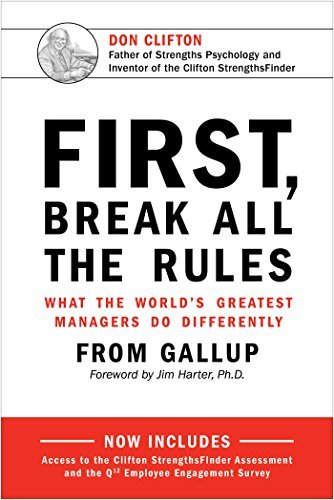
First, Break All The Rules is a management book based on a Gallup study involving more than 80.000 managers.
TPM Strategic Takeaway: This is a rare data-backed look at what actually drives performance—but it misses the power dynamics behind it
The findings are valuable, but top performers don’t just ‘create good environments’—they control incentives, allocate attention strategically, and build high-performing alliances.
Mostly, what’s missing here is also that top performers who advance are also power-intelligent, ‘positively’ calculative, and strategic.
Contents
Notes
Buckingham and Coffman base many of their findings in “First Break All The Rules” on Gallup’s research of 80.000 managers.
There are limits to questionnaires of course, but given the magnitude of the research and the size of the responders, the findings are nonetheless significant.
The 12 Questions for Performance
A positive answer to the question below increases employees and organizational performance.
A negative answer adversely impacts the individual and organizational performance.
- Do I know what is expected of me at work?
- Do I have the materials and equipment I need to do my work right?
- At work, do I have the opportunity to do what I do best every day?
- In the last seven days, have I received recognition or praise for doing good work?
- Does my supervisor or someone at work seem to care about me as a person?
- Is there someone at work who encourages my development?
- At work, do my opinions seem to count?
- Does the mission/purpose of my company make me feel my job is important?
- Are my co-workers committed to doing quality work?
- Do I have a best friend at work?
- In the last six months, has someone at work talked to me about my progress?
- This last year, have I had the opportunity at work to learn and grow?
Open-Ended Questions to Hire Well
The authors say that the best questions to ask at interviews are open-ended.
When you ask them, you should not telegraph any direction.
The direction candidates take is the most telling predictor of their future behavior.
Hire for Talent
Skills can be learned and knowledge can be taught.
The raw material that can hardly be learned or taught is talent, and great managers hire for talent.
There are 3 types of talent:
Buckingham and Coffman break talent into three categories. Striving talents – the “why” of a person. Why they do things, their drive, why they are who they are. Thinking talents – the “how” of a person. How they think, how they rationalize decisions, their values. Relating talents – the “who” of a person. Who they trust, who they confront, who they ignore.
You Can’t Learn Success From Failure
The authors say you cannot learn excellence by studying failure as if excellence was the opposite of failure.
Why not?
Because excellence and failure are often similar!
For example, both great salespeople and poor ones feel like they are selling themselves when they pitch their products.
It’s that personal investment in the product that makes them so persuasive.
That same personal investment though, also makes them more scared of a no.
The difference thoug,h is those great salespeople are not paralyzed by those fears.
Play Favorites
A seemingly popular rule of political correctness these days seems to be that of treating people the same way.
Silly rule, imply the authors.
People are different and have different skills, abilities, and characters. And that’s why you should treat them differently.
Don’t Promote: Find the Right Fit
Career advancement promotes people to their level of incompetence.
Great managers instead understand that not every great employee must be promoted.
Some of them are good where they are, or can grow in areas that don’t entail managerial duties, for which they might not be a good fit.
People Don’t Change: Leverage Their Uniqueness
I loved this part.
In spite of all the self-help literature telling people on how they can change, managers accept that most people don’t change that much.
And we don’t have unlimited potential.
Great managers don’t complain about it though.
They capitalize on it.
They leverage people’s uniqueness instead by seeking jobs that match their talents or moving them in positions that match their talent -or by accepting that someone must be let go-.
In the words of the authors:
Don’t waste time trying to put in what was left out. Try to draw out what was left in
Great Teams Have Great “Is”
It’s not true that great teams don’t have “Is”. Great teams are built with great individuals.
Real-Life Applications
- Leverage people, don’t try to change them
Yes, you can change, and you can change a lot. But that’s not to say that most people will change.
Most people will not change indeed. And you should learn to read people, accept them as they are and try to leverage their unique strengths and contributions instead of wasting time in trying to change them.
- Spend more time with the best
When managers have problematic employees they end up spending a lot of time with those troublemakers rather than their top performer.
Paradoxically then, they are sending the message that troubles get the manager’s attention.
Great managers instead spend more time with their best employees.
Review
The title of “breaking all the rules” feels like a marketing ploy because these supposedly good managers aren’t defying common sense or breaking any big rule, but generally applying common and sound principles.
In general, the book could have been briefer and focused on the 12 questions, but it’s an otherwise excellent resource for corporate learning centers and mid to higher level managers.
Also see:
