
Rationality: What It Is, Why It Seems Scarce, Why It Matters (2021) by Steven Pinker explores human reasoning, its strengths, its limitations, how to increase it, and its critical importance to both individual well-being, and humanity as a whole.
TPM Note: Rationality is foundational to effect change in the real world
This book is not included because of its cultural criticism. It is included because it is influential in modern rationality thinking (though more from a theoretical point of view, and now an how-to guide).

Contents
- Key Takeaways
- Notes
- MORE WISDOM
- QUOTES
- CRITICISM
- Less a book on rationality, more Pinker’s take on rationality
- Not a guide for learning rationality
- Overstates rationality and IQ, ignores cultural learning
- Too much space wasted on ‘common knowledge’
- Over-emphasis on present events make Rationality already dated
- Strawmen arguments
- Some irrational conclusions
- PROS
- REVIEW
Key Takeaways
- Rationality is a public good that we must defend from a tragedy of the commons. Each of us has a motive to prefer our truth, but together we’re better off with the truth.
- Humans are more logical than cognitive biases would suggest, and we’re more accurate when it’s framed as human-relevant
- We adapted to be lawyers more than scientists, to win arguments. Ie.: it’s more about power, than truth
Notes
About the Author:
Steven Pinker is a psychology professor at Harvard and a popular author of books such as “The Better Angels of Our Nature“, “How the Mind Works”, “The Blank Slate“, and Enlightenment Now.
Intro: what’s rationality and why it matters
The author outlines the book’s purpose:
to explain the tools of rationality (logic, probability, critical thinking, etc.), explore why they are underutilized, and affirm their necessity in fostering progress.
Pinker suggests that traditional cognitive psychology fails to fully address contemporary irrationality, such as belief in conspiracy theories.
And he reminds readers that rationality is the cornerstone of human thought and action, essential for addressing pressing global challenges like health crises, democratic erosion, and climate change.
Tools of rationality:
- logic
- critical thinking
- probability
- correlation and causation
- the optimal ways to adjust our beliefs and commit to decisions with uncertain evidence
- yardsticks for making rational choices alone and with others
Be more open to evidence and reflect more for higher rationality
Openness to Evidence correlates with cognitive reflection (the ability to think twice and not fall for trick questions) and with a resistance to many of the cognitive illusions, biases, and fallacies.
This cluster of good cognitive habits, which Stanovich calls the Rationality Quotient (a play on the intelligence quotient or IQ), correlates with raw intelligence, though imperfectly: smart people can be closed-minded and impulsive, and duller ones open and reflective.
Together with resisting weird beliefs, reflective people are better at spotting fake news and at rejecting pseudo-profound bullshit like “Hidden meaning transforms unparalleled abstract beauty.”
We’re more rational than Kahnmann suggests
Just like he’s done in some previous books, Pinker challenges the notion that humans are inherently irrational.
He revisits a theme he already addressed in more evolutionary-leaning previous work, and says that Kahneman’s work led many to believe humans are more irrational than they actually are.
Instead, Pinker points out, those tests are biased to make humans fail.
My note: His example of the San people is unconvincing.
This example doesn’t isolate individual reasoning ability from accumulated cultural knowledge, which makes it weak evidence for innate rationality.
Key Takeaways:
- Humans are capable of remarkable rationality, as seen in hunter-gatherer societies.
- Modern irrationality stems from misapplications of cognitive tools in unfamiliar contexts.
- Rationality is a skill that can be honed through understanding and practice.
- Logic is a powerful but abstract tool that humans apply better in familiar contexts.
The replication crisis was a failure of rationality
On the studies that grab attention:
The notorious replication failures come from studies that attracted attention because their findings were so counterintuitive.
Holding a warm mug makes you friendlier. (“Warm”—get it?) Seeing fast-food logos makes you impatient. Holding a pen between your teeth makes cartoons seem funnier, because it forces your lips into a little smile. Any reader of popular science knows of other cute findings which turned out to be suitable for the satirical Journal of Irreproducible Results.
Pinker explains why it was obvious these much-publicized studies by pop psychologists were likely false to begin with:
The reason these studies were sitting ducks for the replicability snipers is that they had low Bayesian priors. Not as low as ESP, to be sure, but it would be an extraordinary discovery if mood and behavior could be easily pushed around by trivial manipulations of the environment.
It was the extraordinariness of the findings that earned them a place in the science sections of newspapers and snazzy ideas festivals, and it’s why on Bayesian grounds we should demand extraordinary evidence before believing them. Indeed, a bias toward oddball findings can turn science journalism into a high-volume error dispenser.
Indeed, acutely notes Pinker, the mere fact of something being surprising makes it more likely to be wrong:
The problem is that “surprising” is a synonym for “low prior probability,” assuming that our cumulative scientific understanding is not worthless. This means that even if the quality of evidence is constant, we should have a lower credence in claims that are surprising.
The forbidden truths people deny
Rephrased for speed:
The stage for forbidden base rates is set by a law of social science.
Measure any socially significant variable: test scores, vocational interests, social trust, income, marriage rates, rates of different types of violence.
Now break down the results by the standard demographic dividers: age, sex, race, religion, ethnicity. The average differences among groups are sometimes very large.
Whether the differences arise from nature, culture, discrimination, history, or some combination is beside the point: the differences are there.
To use these differences to enact policy or decision-making may be rational.
But it would also be textbook profiling:
Say you sought the most accurate possible prediction about the prospects of an individual—how successful the person would be in college or on the job, how good a credit risk, how likely to have committed a crime, or jump bail, or recidivate, or carry out a terrorist attack.
If you were a good Bayesian, you’d start with the base rate for that person’s age, sex, class, race, ethnicity, and religion, and adjust by the person’s particulars. In other words, you’d engage in profiling. You would perpetrate prejudice not out of ignorance, hatred, supremacy, or any of the -isms or -phobias, but from an objective effort to make the most accurate prediction.
Self and Others (Game Theory)
The chapter on game theory was one of the most interesting for our focus on self-development and goal achievement.
It applies game theory to real-world scenarios like communal outrage, environmental policy, and international relations, highlighting the importance of aligning individual and collective rationality.
The environment is a tragedy of commons
To get back to the example with which I opened the chapter, here is the Tragedy of the Carbon Commons. The players can be individual citizens, with the burden consisting of the inconvenience of forgoing meat, plane travel, or gas-guzzling SUVs. Or they can be entire countries, in which case the burden is the drag on the economy from forgoing the cheap and portable energy from fossil fuels.
Pinker says this realization undermines radical libertarianism, “despite the eternal appeal of unfettered freedom”.
I agree.
Key Takeaways:
- Rationality is a public good with a tragedy of the commons in tow. Each of us has a motive to prefer our truth, but together we’re better off with the truth.
- Cooperation can emerge from strategic interactions of selfish players, as seen in Tit for Tat.
- Game theory can improve social and policy outcomes.
- Social animals often play in a series of iterated prisoner dilemmas. But the iteration makes cooperation beneficial and common
What’s Wrong with People? Clannisshness VS truth
Pinker dedicates a full chapter addressing the apparent irrationality crisis of conspiracy theories, fake news, and polarized politics.
Pinker argues that these phenomena often reflect rational pursuit of non-epistemic goals, like signaling group loyalty (myside bias) or seeking comfort in a mythology mindset.
He says that politics have become bigger ideology machines:
We’ve long known that humans are keen to divide themselves into competitive teams, but it’s not clear why it’s now the left–right split that is pulling each side’s rationality in different directions rather than the customary fault lines of religion, race, and class.
The right–left axis aligns with several moral and ideological dimensions: hierarchical versus egalitarian, libertarian versus communitarian, throne-and-altar versus Enlightenment, tribal versus cosmopolitan, tragic versus utopian visions, honor versus dignity cultures, binding versus individualizing moralities.
Pinker distinguishes between the reality mindset (evidence-based reasoning) and the mythology mindset (beliefs for social or emotional purposes).
People don’t really ‘believe’ fake news and conspiracies, they just promote them to advertise group belonging or influencing the narrative.
Key Takeaways:
- Irrational beliefs often serve social or emotional functions, not just cognitive errors.
- The mythology mindset prioritizes group identity over truth.
- Education and institutional accountability can counter the irrationality crisis.
Why rationality matters
In the final chapter Pinker seeks to leave us with a parting argument on why rationality matters.
Some points make sense, but some felt less convincing.
Overall, the last chapter felt biased to favor Pinker’s favored outcome: that rationality makes a huge difference.
Key Takeaways:
- Rationality has driven significant material and moral progress.
- Strengthening rationality requires education, institutional reforms, and cultural norms.
- Rationality is a collective asset vital for a flourishing society.
MORE WISDOM
Shit tests with hypotheticals
A person who is capable of entertaining certain hypotheticals might stab us in the back were the temptation ever to arise.
Imagine someone were to ask you: For how much money would you sell your child? Or your friendship, or citizenship, or sexual favors?
That’s a trap/shit test.
And, says Pinker:
The correct answer is to refuse to answer—better still, to be offended by the question.
(…) We trust those who are constitutionally incapable of betraying us or our values, not those who have merely chosen not to do so thus far.
Randomized controlled trials aren’t ‘golden standard for showing causation’
Randomness is the key: if the patients who were given the drug signed up earlier, or lived closer to the hospital, or had more interesting symptoms, than the patients who were given the placebo, you’ll never know whether the drug worked.
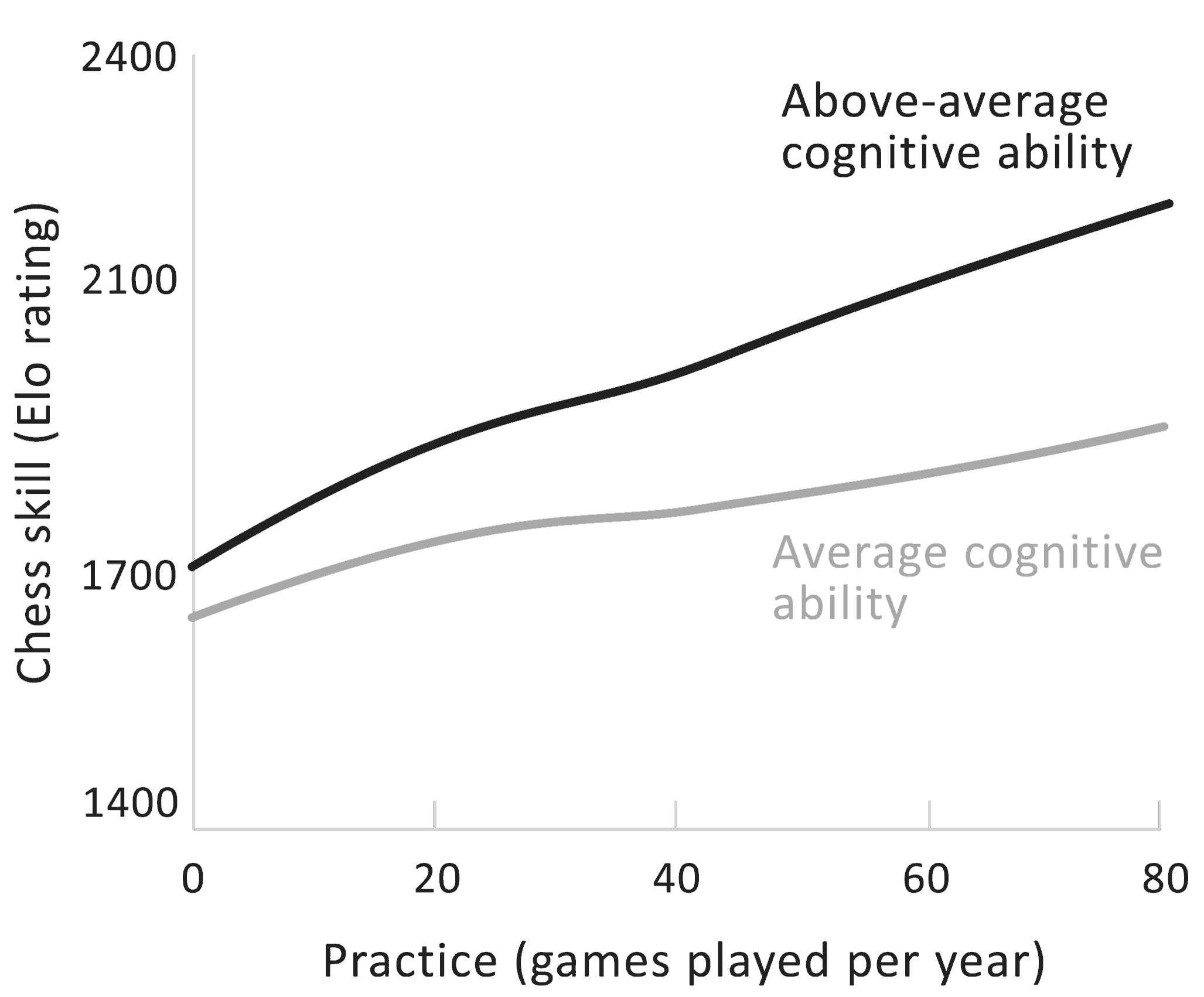
Talent matters: increasing practice increases the difference between talent and non talent
Smarter players gain more with every additional game of practice. An equivalent way of putting it is that without practice, cognitive ability barely matters (the leftmost tips of the lines almost overlap), but with practice, smarter players show off their talent (the rightmost tips are spread apart)
QUOTES
Rationality as a public good, probably the best concept and quote in the whole book:
Rationality is a public good, and a public good sets the stage for a tragedy of the commons. In the Tragedy of the Rationality Commons, motivated reasoning for the benefit of oneself and one’s side produces an opportunity to free ride on our collective understanding.
Each of us has a motive to prefer our truth, but together we’re better off with the truth.
On the difference between claiming conspiratory beliefs, and living accordingly to them
even relativists who deny the possibility of objective truth and insist that all claims are merely the narratives of a culture lack the courage of their convictions. The cultural anthropologists or literary scholars who avow that the truths of science are merely the narratives of one culture will still have their child’s infection treated with antibiotics prescribed by a physician
On scientists’ own failure of rationality and publication irrationality:
A failure of Bayesian reasoning among scientists themselves is a contributor to the replicability crisis.
(…) Daryl Bem published results (…) which claimed to show that participants successfully predicted (at a rate above chance) random events before they took place (…) Not surprisingly, the effects failed to replicate, but that was a foregone conclusion given the infinitesimal prior probability that a social psychologist had disproven the laws of physics
CRITICISM
Less a book on rationality, more Pinker’s take on rationality
While the author does discuss principles of rationality, they’re drowned out in personal takes, anecdotes, and tangents.
The book feels more like philosophizing over rationality than dispassionately analyzing rationality.
Not a guide for learning rationality
While the book does discuss how rationality works, it doesn’t deliver the guide on how to be more rational that I was hoping for.
Overstates rationality and IQ, ignores cultural learning
The San people didn’t feel like compelling evidence for human rationality in decision-making.
After I had the fortune of learning about cultural evolution, Pinker’s example struck me more as a case of cultural learning, than unfettered rationality.
I’d recommend Pinker to sit down with his fellow Harvard professor Henrich and learn more about:
Too much space wasted on ‘common knowledge’
Readers well-versed in foundational principles of cognitive psychology may feel like Rationality wastes valuable space to revisit known themes without bringing anything new to the table.
The same can be said for the usual obvious holes in human rationality, like overestimating the risks of terrorism, or of airplane travel risks.
Several themes also repeat from Pinker’s previous books.
And as much as I agree with them, I wasn’t looking for a rerun.
I think an assertive editor should have reminded Pinker on when and where to cut.
Over-emphasis on present events make Rationality already dated
Human biases that Pinker failed to heed are over-weighing present events, and extrapolating recent trends onto the future.
Pinker hints that the US is moving away from Trump’s denials of facts and truths, and back to rationality:
He says:
These safeguards are belatedly being deployed.
In a single week in early 2021 (…) Trump was banned from Twitter (…) a mendacious senator who pushed the stolen-election conspiracy lost a major book contrac (…) The platforms have tuned their algorithms to stop rewarding dangerous falsehoods (…) and damped down the runaway dynamics that can viralize toxic content and send people down extremist rabbit hole
History proved this misleading.
Trump won again in 2024, making that chapter a cautionary tale of not jumping to conclusions.
Strawmen arguments
For example:
All too often, people write as if every outcome had a single, unfailing cause (…)
He may be right that too many do it way too often.
But I believe that it’s more often a case of power dynamics, and seeking to persuade, win arguments, or increase engagement, than about true irrationality.
Most people instead would agree that both nature/nurture and talent/practice matter.
Simplistic arguments
For example, pitting against the supposed hyper-rationality of the San people with modern human societies:
The sapience of the San makes the puzzle of human rationality acute.
Despite our ancient capacity for reason, today we are flooded with reminders of the fallacies and follies of our fellows
Does Pinker really believe that an average San is so much more rational than an average modern man?
Because I don’t think so.
Not that the modern society man is more rational, but simply that there is no reason to believe a San is more rational than any other random human being.
Some irrational conclusions
Seems like Pinker may slip on rationality seeking to be an optimist:
“If the smartest people in the world predict something, it will come true.” But we know that this conditional is false.
Einstein, for example, announced in 1952 that only the creation of a world government, P, would prevent the impending self-destruction of mankind, Q (if not P then Q), yet no world government was created (not P) and mankind did not destroy itself (not Q; at least if “impending” means “within several decades”).
Pinker may want to note there is no timeline in Einstein’s prediction.
A prediction without a timeline cannot be proven false because ‘there is always time for the prediction to become true’.
PROS
We need more rationality, and all the help we can get to promote it
I stand beside Pinker’s message on the importance of rationality for the sake of humanity as a whole.
For that, I applaud Pinker’s effort on this arena and I’m glad a popular scientist is fighting this good battle.
Respect for Pinker’s stand against both left & right irrationality
In the past some may have seen Pinker’s criticism of academic wokism as a sign of his conservatism.
However, Pinker took an even stronger stance against Trump.
That suggests me Pinker truly puts values above politics, something I deeply respect (and a stance we also happen to agree with here at TPM):
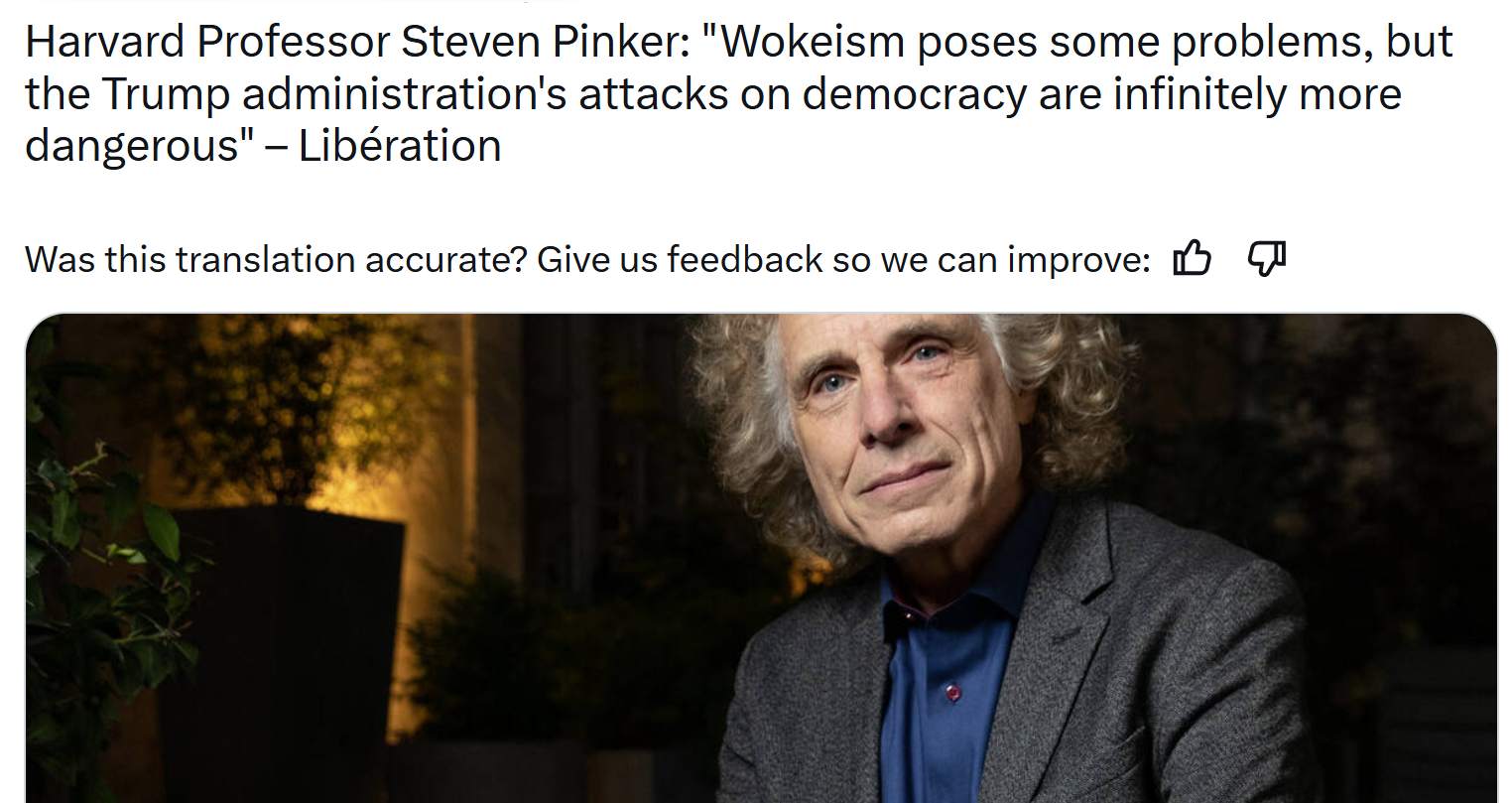
Pinker: Wokism poses some problem, but Trump’s attacks on democracy are worse
Much respect to Pinker for defending academic freedom and the pursuit of truth above and beyond any politics 🦅
REVIEW
Rationality is a typical Pinker book mixing deep insights and some science with lots of Pinker’s takes and opinions.
You’ll love the latter if you love Pinker, and you’ll love Rationality a bit less if you were looking for fewer tangents and more science and pragmatism.
I wished it were more of the latter.
With all his clever quips and quotes Pinker’s books make you think ‘he’s smart’. But I want books that make readers smarter.
I could not agree more with the author for the call on more rationality, including for humanity’s own sake and future.
And I also believe rationality is a meta-skill for life’s success and effectiveness.
So I wished that a smart and capable thinker like Pinker could pen a stronger manifesto.
With less Pinker-ing, and more dispassionate pragmatism Rationality could have been a manifesto. As it stands, it’s not, and it left me wishing for more.
Check the best books to read or get this book on Amazon.
