
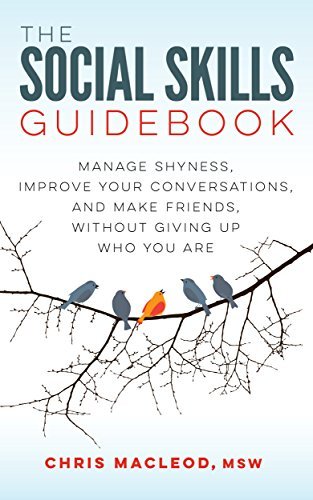
The Social Skills Guidebook (2016) is a guide for teaching social skills and general social dynamics.
Chris MacLeod, the author, covers the basics of socialization while also delivering deep value and insights that everyone can learn from.
Summary
About the Author: Chris MacLeod is a fellow writer on social dynamics and social skills.
He describes himself as a former shy, lonely, and awkward teenager and young adult. He worked on himself to change from shy and awkward to a socially effective human being, and he writes about the resources he wished he had when growing up. He holds a bachelor’s in psychology and a Master’s in Social Work, with a focus on counseling. Chris is also an active writer on his personal blog.
Introduction
I couldn’t agree more with Chris MacLeod when he says that the most charismatic people are not using any special techniques, but they are executing the basics better than most.
The Social Skills Guidebook is more aimed at beginners who are very shy or somewhat socially awkward.
Yet it deals with the basics so well that most people can learn how to become more charismatic
Expect 1-3 Years to Get Good
The author says that everyone is different, so it’s not actually possible to give an estimate on “how long it will take to get good socially”.
However, he makes a very good point in saying that people should not trust or believe sources that promise instant change.
Expecting instant change can have adverse effects on people who don’t see those overnight improvements. They might get frustrated, lose heart, and even give up.
Limiting Thought-Pattern
The author dedicates a whole chapter to the limiting thought patterns that people often end up in.
There are many of them, all good and very relevant from a psychological and social-dynamics point of view.
Here are some of them:
- Jumping to conclusions
Jumping to conclusions often means “jumping to negative conclusions”, with bad self-talk such as “I had a bad conversation, it’s because I am hopeless” or “the group didn’t accept me, I am a real social reject”.
On a smaller scale, jumping to conclusions also often leads to misunderstandings when we assign certain intentions to actions for which we actually have no clue.
- Filtering to support negative assumptions
People who fall prey to jumping to conclusions and making negative assumptions will filter out all positive stimuli and focus on the ones that reinforce their negative narrative.
- Interpreting reality based on negative emotional states
Chris MacLeod says that people assign “rating difficulties” to social interactions based on how they’re feeling.
So if they are feeling anxious or nervous for any reason, they think that social interactions are difficult and/or that they’re not good enough for it.
But your emotional states have little to do with reality and/or the difficulty of social interactions.
This is very true, and generalizing our emotional states to our interpretation of reality is a well-known psychological principle with many interesting ramifications.
- Catastrophizing
Catastrophizing means focusing on the worst possible outcome.
As unlikely as that outcome might be, focusing on it only increases the chances of it happening… And it unnecessarily raises our stress levels and social tension.
- “I’m responsible for all bad interactions”
No, you’re not, a conversation and a social interaction entail at least two people, and your speaking partner is as responsible as you are.
As a matter of fact, some interactions will always be bad, and you will eventually meet some people with whom it’s impossible to have positive interactions.
My Note:
Taking Extreme Ownership of everything that happens to you can be a powerful tool for life.
But it needs strong self-esteem and an antifragile ego. For people who are not there yet, people with low esteem, or people who still see many more failures than victories, it’s indeed best not to take full ownership.
Take Small Steps
Starting with big challenges you are not comfortable with is the best way to make it too hard on yourself and to increase the chances you won’t see any improvement any time soon and that you will quit.
Instead, start small with something you are kind of comfortable with, not super comfortable.
Only move up to more difficult social challenges once you are 100% comfortable with the level you’re at.
Dealing With Silences
First of all, silences happen all the time, and they are a sign that people are comfortable with each other and good friends.
You don’t need to fill in all the conversational gaps.
However, there is no denying that silence can also happen with people you are not very familiar with, and it can get awkward.
If it’s becoming awkward, avoid commenting on it and saying how awkward it is.
If you want to say something, you can say”
“alright I guess there is not much more to say about that”
And the change of topic.
Or change the topic without saying anything.
Don’t Force Uniqueness
The author says that the suggestion of being unique and avoiding all standard lines is overrated.
Instead, it’s OK to have some commonplace statements, comments, or topics.
And it can be quite awkward when you try to force the super personal question or the “unexpected topic that grabs attention”.
I couldn’t agree more, and that’s why I downrated social skills products such as Charisma University, Charisma on Command, Captivate, etc.
Don’t Hog The Conversation…
Conversations are two-way streets.
People who hog the conversation and take most or all the speaking time bore people to tears and come across as extremely selfish, self-centered, and entitled.
It makes people feel like they don’t matter, and they will react by excusing themselves (or resenting you if they can’t move).
…Unless They’re Not Contributing, In Which Case: Talk
This is a bit more advanced, but if the other person is not contributing much, they might need to be made more comfortable.
Albeit hogging the conversation is usually not good, this is an exception when doing most of the talking can help draw shyer and more reserved people out until they are comfortable contributing more.
Should You Share Personal Stories?
The recent work on vulnerability by Brene Brown (Daring Greatly etc.) has made some people believe that connecting is all about sharing and that courage is opening up.
Yes… When you know someone well and at the right time.
Otherwise, oversharing too soon is awkward and a big red flag.
But Do Share At The Right Time
But, says the author, the virtue is in the middle.
Not sharing anything leaves the conversation dry and makes people feel like you don’t trust them.
This is especially true if you are getting to know each other better and if they share something personal first.
Asperger’s Syndrome
In the last chapter, Chris MacLeod talks about Asperger’s Syndrome and how it adversely impacts social skills.
It’s very enlightening, and it made me reflect on whether or not Aspergers are best suited to teach social skills to non-Aspergers.
I already reviewed a social skills book from an author affected by Aspergers, and it was actually very good. However, it’s hard to learn all the nuances that you don’t naturally get. And that might make Asperger’s non-ideal teachers non-Aspergers.
At least when it comes to more advanced forms of emotional intelligence and leadership.
Real-Life Applications
- Say Something: Filter Yourself Less
Chris MacLeod says that a lot of conversational difficulties arise among beginners because they censor themselves too much and are always wondering “can I say this, or should I not say that?”.
But saying something, whatever it is, is often better than saying nothing.
- Don’t Jump to Conclusions on People’s Shallowness
It’s easy to think of others as shallow because you have access to your deeper thoughts and feelings, while you judge others based on what you see and the superficial conversation that’s going on.
That was very deep indeed :).
- Self-Esteem Trails Accomplishments & Skills
Keep in mind that our self-esteem usually trails our actual level. Don’t let impostor syndrome stunt your growth.
CONS
No cons concerning target readership of MacLeod’s book.
You might think that a book on the basics might bore a more advanced student. But instead, it was a good refresher. I found myself nodding most of the time, and I gleaned quite a few new insights as well.
Our only con is that ambitious men who want more advanced results like status, respect, and attraction need something else after this book.
PROS
- Broad, Yet Exhaustive
The Social Skills Guidebook talks about most of the relevant topics in basic social skills.
Yet it also manages to be exhaustive enough with each of them to cover most of what makes people effectively function as social animals.
- Practical Examples
The examples are scattered all over, and sometimes they are just simple, short sentences.
Yet, they work very well to make people understand the more abstract concepts that social and emotional intelligence are made of.
- Good Mix of Basics & Advanced
The author often starts with the basics, but then adds a few exceptions to the rules that will satisfy more advanced students.
That helps the readers bridge gaps of understanding between the general rules and the exceptions (for example, in group conversations).
- Some Basic Power Moves As Well
The author also has good suggestions on defending your speaking time from more aggressive social players who might want to cut you off (for example: raise your voice, raise a hand as if to say ” wait,” or add “woh-woh, I’m not done, I’m not done).
- Great Narrating Voice
The narrator is wonderful.
It makes a huge difference when he recites the dialogue examples and adds real value with his vocal variety.
Review
High rating for The Social Skills Guidebook.
It covers the basics while also delivering lots of value for more advanced students of the social arts (and sciences).
Most importantly, it covers both the basics and more advanced topics with factual and very accurate information, which shows that Chris MacLeod knows what he’s talking about and is very well-informed.
As a matter of fact, The Social Skills Guidebook is one of the best social skills books I have read and a rather underrated book.
If you’re an ambitious man lacking social skills, get this book first and then come back to TPM for status, respect, attraction, and top-1% results.
Check the best social skills books, or get the book on Amazon
The Social Skills Guidebook: Summary & Review (Macleod)
One of the best books on social skills. Especially great for beginners.
URL: https://thepowermoves.com/the-social-skills-guidebook/
Author: Lucio Buffalmano
4.5
