
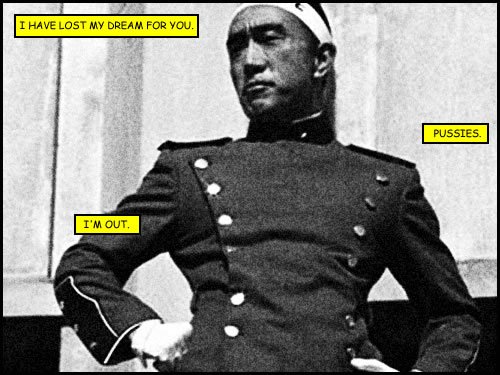
On November 25, 1970, author Yukio Mishima and handful of compatriots took the commandant of a military base hostage and commanded the attention of a nation. His men were armed only with samurai swords. With news helicopters buzzing overhead he asked the assembled soldiers at the base to rise up and proudly reclaim their manly national heritage.
He was rebuffed, as he expected he would be. Mishima left the balcony from which he was speaking and returned to the office where the horrified commandant and his loyal men looked on. Then, according to plan, he committed hara-kiri.
Mishima didn’t disembowel himself because he was depressed, or hopeless, or insane. He killed himself to make a point.
Mishima is a personal hero of mine and in the years since I discovered him I have observed the date of his departure and paused to reflect on the meaning of his artful human sacrifice.
Mishima called the Hagakure—an 18th century collection of reflections on the way of the Samurai— the “womb of his oeuvre.” He believed that post-World War II Japan had abandoned its virile warrior tradition in favor of becoming a commercialized, soulless nation synonymous with “flower arranging.” Given Japan’s current status as the global hub of Hello Kitty cuteness, he’s probably glad he’s dead.
Samurai, the men Mishima respected and probably romanticized, were known to have been fastidious about their appearances, and they sometimes wore makeup in preparation for death. A samurai wanted to leave a good-looking corpse—one that his enemies would respect as a worthy adversary.
This would seem related to contemporary interest in male vanity, but it isn’t. Today’s male vanity isn’t the vanity of strength and virility, but the soulless vanity of social decay. It is a passive-aggressive vanity, a vanity that seeks status and influence through being desired or pretty or pleasant-looking. It is not about being prepared to meet your doom with dignity and honor, but rather a trivial obsession with appearances for the sake of appearance alone. It is a decorative vanity, not a harmonious confluence of form and function.
In 1994, British journalist Mark Simpson coined the term “metrosexual” in a now infamous article titled “Here Come the Mirror Men.” He wrote:
“Metrosexual man, the single young man with a high disposable income, living or working in the city (because that’s where all the best shops are), is perhaps the most promising consumer market of the decade. In the Eighties he was only to be found inside fashion magazines such as GQ, in television advertisements for Levis jeans or in gay bars. In the Nineties, he’s everywhere and he’s going shopping.”
It wasn’t Simpson’s fault. He was describing a change that was already happening. Men were being relieved of their responsibilities, relieved of purpose. No longer expected to bring home the bacon, men were free to busy themselves hunting the most fashionable fall “look” or the best moisturizer.
In hindsight, we know that men were ultimately unable to compete with women as avid consumers. A new generation of men may have embraced AXE and they may even “manscape,” but in most cases they are doing it for the same old reason: to impress chicks and get them in the sack. (We can call it “game” if you like.)
Women still generally get dressed up, as John Cougar Mellencamp noted, “for each other.” And that makes their vanity a full time obsession.
However, even that may be changing. On the heels of Simpson’s metrosexual, the Japanese, always on the bleeding edge, seem to have one-upped us in the worship of Cybele with their “Herbivore” men. The trend was spotted and named by Japanese pop culture columnist Maki Fukasawa in 2006, and it refers to males who are not interested in “the flesh” as more “carnivorous” men would be. They are interested in fashion and cosmetics and appearances, but they are not particularly interested in sex or finding girlfriends—though they are not necessarily homosexuals, either. The herbivores are males of little means, who are nevertheless obsessed with frivolous consumerism and passing fads. They seem to be perpetual teenagers, like many gays who follow celebrity gossip, fashion and pop culture fads well into middle age.
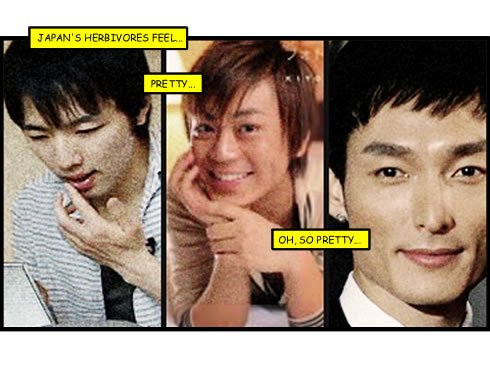
Some blame an economic slowdown and a scarcity of viable career options for young men. Others see an exciting move away from traditional gender roles. Feminists are tickled, of course.
In Manliness, Harvey C. Mansfield wrote that:
“…there is no backlash; there is only inarticulate resistance in the form of reluctance, a residual, bodily, behavioral unwillingness on the part of men to do their share in the upkeep of gender neutrality.”
If you are reading this, you are part of the articulate resistance. (So is Mansfield.) Japan’s herbivores give us a window into the future, and a key to understanding the reluctance of men to completely embrace feminism’s gender neutral ideal. When feminists encourage men to reject traditional notions of masculinity, they speak wistfully of the newfound freedom that lies just beyond the strict constraints of the manly ideal.
The problem is that over there, over the rainbow, is this. THIS is what feminism has to offer men. A gender neutral world offers men the freedom to be “herbivorous.” Feminism offers men the freedom to be weak, to be passive, and to be obsessed with fashion and cosmetics— safe from the cruel disapproval of manlier men. The aim of feminism is spiritual parricide—to purge society of all masculine ideals and do away with manly men altogether. Feminism offers men a set of freedoms they never asked for, never wanted. A gender neutral society offers men freedom to be effeminate and impotent.
What gain is this?
EPILOGUE
 Somewhere in Tokyo, there is a loudspeaker barking something militant. As it approaches, we see a black van, and hear…
「諸君の中に一人でも俺と一緒に立つ奴はいないのか。」
“Among you gentlemen is there not one single person who will stand with me?”
The words are Mishima’s.
They are from his very last speech, given 39 years ago this week.

Jack Donovan is the author of Androphilia and the co-author of Blood-Brotherhood and Other Rites of Male Alliance. He lives in Portland, Oregon and works in the fitness industry.
He also runs the Yukio Mishima tribute site, Headlessgod.com
