
For most men, it begins with purpose.
Readership: All
Theme: Redemptive Headship and Masculinity
Reader’s Note: The capitalization of words indicates a theoretical concept.
Length: 1,500 words
Reading Time: 8 minutes
Introduction
St. Dalrock was he who first brought our attention to the fact that Western culture has somehow developed a propensity to disrespect respectability and dishonor the honorable. As such, it is now commonplace for immoral and unethical men to receive honor and respect, and average men see little value in being respectable or honorable.
We’ve discussed this phenomenon in the comments sections under the following posts.
- Σ Frame: The Status Signaling Narrative (2022-3-21)
- Σ Frame: “Saving the seeds of civilization while the fire rushes over the forest.” (2022-4-27)
- Σ Frame: Faux Masculine Archetypes (2022-5-2)
- Σ Frame: The Bungling Dimwitted Lazy Husband (2022-5-9)
- Σ Frame: Red Pill Redemption (2022-9-5)
 Roger Bannister was the first to break the 4 minute mile.
 The most pertinent questions addressed were…
- Why is there a moral incongruency surrounding Honor and Respect?
- What is the profile of a man who “rightfully deserves the respect of other men”? What does that profile look like?
- What can be done to assign honor and respect to those men who are rightfully deserving of it?
These are the questions I had in mind during the study of Faux-Masculine Archetypes in May 2022. In this study, I set forth 5 benchmarks of Masculinity to form an objective and qualitative criteria which were then used to evaluate each of the archetypes. These five benchmarks form the acronym SHARP (or HARPS) and have the subcategories listed below.
- Strength — Athleticism; Endurance; Maintaining Frame; Physical Strength; Stamina;
- Honor — Ethics; Honesty; Identity; Morality; Reputation; Social Status;
- Authority — Education; Influence; Position; Power; Socioeconomic Status;
- Respect — Abilities / Skills; Authenticity; Charisma; Excellence; Integrity; SMV;
- Purpose — Attaining Goals; Discipline; Incentives / Motivations; Meaning / Significance / Value; Perseverance;
This examination of Masculine traits and archetypes and our discussions (noted above) considered the questions above and found the following.
Concerning Honor
- Honor is a difficult balance to attain / maintain, because Ethics and Morality often have a negative correlation with Status, presumably because of competition in a fallen world.
- Among the things that deliver Honor, Reputation and Status carry more weight than Ethics and Morality, again, because of competition. (I will develop this further below.)
- Universal but rare exceptions to this moral dichotomy include instances of heroism and exceptional valor.
- Qualities related to Honor are highly dependent on the ethical system employed by the wider social group.
- Man’s identity, ethics, and morality are necessarily tied to Honor. If it is not, then although a man might receive honor for whatever reason, that man may not necessarily be inherently honorable, by definition. (For example, veterans receive honor for their bravery and service, not for the horrendous things they did in battle.)
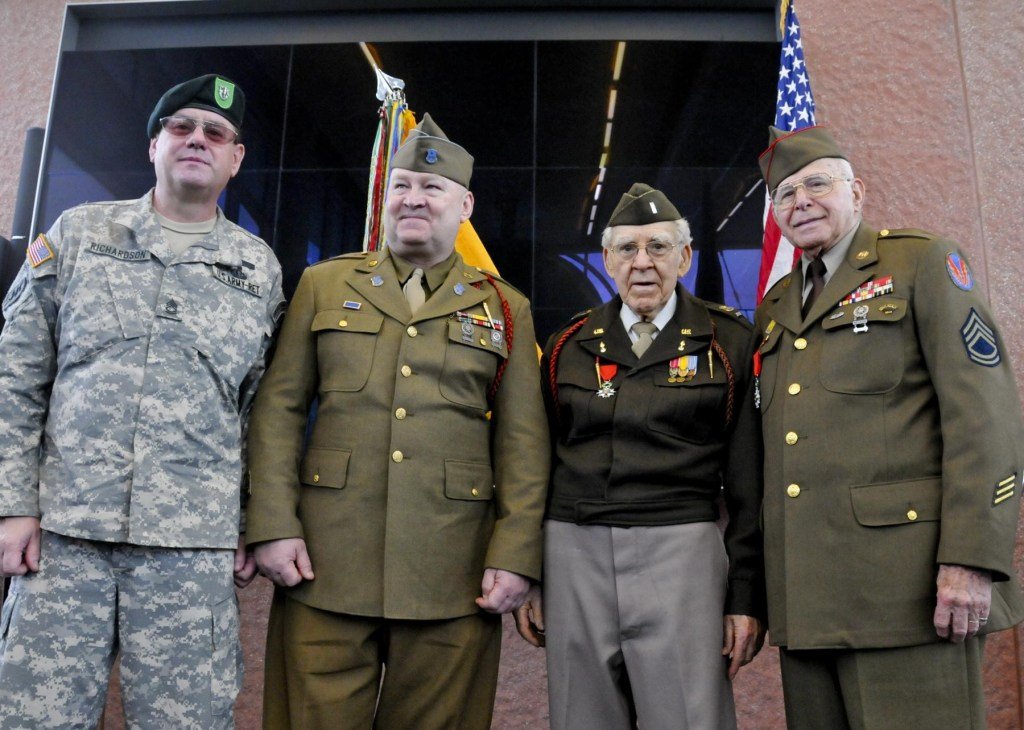 Image Source: U.S. Army: Old Hickory WWII veteran honored for service, past and present (2014-1-12)
 Concerning Respect
- The archetypes scoring highest in masculinity also scored the highest in Respect.
- The culmination of masculinity is summarily manifested in Respect.
- The core spiritual effectiveness of Masculinity hinges on Respect, which is possibly why St. Paul emphasized that wives should respect their husbands (Ephesians 5:33).
- Respect is linked to Authority through Power.
Comprehensive
- That which makes a man honorable are internal characteristics like character, courage, honesty, and willpower, whereas that which brings a man respect are inherent qualities related to Strength (e.g. endurance, Frame, stamina, etc.), Virtuosity, Status, and Authority (e.g. power, influence, etc.).
- The things which make a man honorable (i.e. ethics, honesty, service, valor, etc.) have no direct relation to those qualities that make him respectable (i.e. expertise, authority, charisma, SMV, etc.).
- Certain achievements can garner both Honor and Respect if limited to a specific demographic, but these are rare and hard won. (For example, Julian Assange, Martin Luther King, Ronald Reagan, and other popular dignitaries.)
 Julian Assange changed the face of journalism, politics, and history, and was persecuted by powerful foes.
 There is one revision from my earlier study of Faux-Masculine Archetypes. In my earlier assessment, I included Abilities / Skills under the category of Respect and mentioned that these traits branch across Authority and Purpose. But after studying this a bit more, I’ve come to see that respect is not always given to a man simply because he possesses an ability or skill (e.g. think of gamers or amateur hobbyists), but only when he has achieved a mastery / virtuosity of an ability / skill that is appreciated by the larger social group in question. This is why I advised men to find a social context in which Reality = True (for himself) in which he can develop Flow and work toward mastery.
On a related note, one previous post, What Women find Attractive: Fit and Skilled (2022-4-18), reported an opinion from a female reader saying that women are attracted to men with skills. After considering the above, it would be more precise to say that women are attracted to men who demonstrate mastery / virtuosity in a skill recognized by other men (within a shared social group) to have value, as this leads directly to Respect.
Comprehensively, it is observed that Honor and Respect are somehow intertwined with Strength, Authority, and Purpose through a complex function involving various other characteristics, experiences, and traits, such as Abilities / Skills, Confidence / Charisma, SMV, and others.
To aid our understanding of the dynamic development of masculinity, I’ve studied all these aspects closely and put together the following system diagram. There is no note of spiritual qualities in this graph, because it pertains to the masculine development of all men.

The diagram illustrates the cause and effect relationships between these features of masculinity, how they occur in a certain order, and that they have a rather complex interrelation.
Strength, Honor, Authority, Respect, and Purpose (SHARP) roughly correlate with Donal Graeme’s Looks, Athleticism, Money, Power, and Status (LAMPS). The difference is that LAMPS comes from the perspective of what women find attractive in men and thus forms the primary basis of a man’s SMV, whereas SHARP comes from the male viewpoint of masculine development.
Confidence and Charisma are often added to LAMPS as an SMV determinant, and the diagram shows why this is appropriate, as it feeds directly into Respect according to the above nomenclature.
Experience (indicated by the circular purple background) lends to the development of all these aspects of masculinity.
Critiques and suggestions for improvement are welcomed from readers.
For further insights, erudite readers may like to discuss how well the relations shown in the above system diagram agree with what they know about human nature and sociality from the Bible. I expect the ongoing discussion of Honor and Respect will be interesting.
Applying the Systems Diagram to Intersexual Relationships
A man’s journey all begins with the self, summarily represented in the diagram as Strength.
From studying this diagram, it becomes apparent why the top SMV men can jump ahead of everyone else without first having to prove themselves –- because having external strength and especially a high SMV are shortcuts to Respect. (Not to mention the additional bonus that Tingles = Respect from an intersexual perspective.)
Most men have to go the route of Purpose, work hard towards developing and mastering a skill in order to take the roundabout path to Respect.
A few men will fare well through Honor displayed through Courage and Competition.
From a social perspective, honor and respect are predominantly offered to those men with a demonstrated utility either to the wellbeing of the community or to Feminine Imperatives. Readers have argued about whether the latter is morally or ethically appropriate, and I would say most of the objections are based on one of the following cofactors.
- Envy
- Implicit sexual immorality.
- The inversion of Headship.
- The idolatry of female pedestalization.
The lurking question of Ethics (one aspect of Honor) can be properly understood when we recognize that human mating dissolves the backdrop cultural ethics and resorts to a Power based ethic. That is to say, the winner is deemed “good” by virtue of his being a winner, and “Might is Right”. Such is the Law of the Jungle.

In spite of any moral expectations or ethical considerations we might have, the old Manospherian adage stands true: “Women wait at the finish line and choose the winners.” Here, the “winners” are those men who have successfully gone through all the steps necessary to attain Respect.
The nature of female hypergamy recasts men as falling into an AMOG-ish competition for dominance, proficiency, Reputation / Status, etc. As seen in the diagram, hypergamic screening is, at its root, a very quick and dirty way (quite literally) for women to filter men according to their relative progress in Confidence, Expertise, and Virtuosity (expressed through Game) and the concreted Reputation and Status aspects of Honor (as determined by the social In-Group and the personal tastes of the observer).
This also emphasizes why women are drawn to a wide array of specific indicators of masculinity, such as Authority, Confidence / Charisma, preselection, Status, being respected by other men, etc. These traits are very near the “finish line”.
The diagram also reveals why habits and traits related to Honor and Purpose are entirely omitted from one’s SMV evaluation and thus go unnoticed by Women. These characteristics appear early in the “race” and may not be proven. OTOH, men are acutely aware of these things because they inform him of what kind of relationship with that man is most appropriate, e.g. friend, partner, peer competitor, teacher, student, coach, mentor, etc,
The Manosphere commonly cites Purpose as one of the most important tasks in a man’s life. What we’ve learned about Purpose here does not contradict the common RP wisdom, nor does it imply that Purpose is of any lesser value. Purpose is what motivates a man and carries him through these steps and processes.
One more final note. Inside a sexual/marital relationship, the area of Relationships feeds into Purpose and Abilities / Skills concerning how to exercise Headship, manage the household, wash the wife clean, and rear children. (This loop is not shown in the diagram.) It doesn’t work the other way though, and this is why it is a major error for men to think they can make having a relationship with a woman into their purpose. A man cannot very well jump outside the flows depicted in the diagram, and it is practically impossible for him to swim upstream.
In the next post about Understanding Respect, I will give answers to the three questions in the introduction.
Update: In the comments below, Oscar and Thedeti have done a fine job of flushing out the finer details of the differences between Honor and Respect.
Related
- Σ Frame: Imposing Masculine Presence (2022-6-10)
